 Search
Few other people on the left have played such a central role in major global solidarity campaigns as the German Willi Münzenberg (1889-1940).
By Jesper Jørgensen | 07.09.2015
During World War I, he was the leader of the Youth International, which was the strongest force in the anti-war movement. After the war, he coordinated the international campaign for the hungry in the Soviet Union, which later became the International Workers’ Aid organization under the Communist International (Comintern).

He has been called ‘the red millionaire’ and ‘Moscow’s secret propaganda czar in the West’ because he built a large and influential communist media empire in interwar Germany, including magazine and publishing companies, film production and distribution of Russian films. He was also a member of the Reichstag of the Communist Party of Germany, and finally, he helped found the front organization ‘League against Imperialism and for National Independence’.
After 1933, from exile in France, he was particularly involved in anti-fascist campaigns and popular front initiatives against Nazi Germany. After the conclusion of the German-Soviet Non-Aggression Pact in 1939, he broke with Soviet communism and became a high-profile critic of Stalin. Only a year later, he died under mysterious circumstances while escaping from a French internment camp.
Global thinking, networking and inter-political and transnational actions in social movements characterized Münzenberg’s political life – and are therefore the themes of the ‘Global Spaces for Radical Solidarity – First International Willi Münzenberg Congress’ to be held in Berlin on 17-20 September 2015. The aim of the conference is to present and analyze the actors, forms and practices of global solidarity networks in the context of social, cultural and humanitarian movements of the 20th century.
The conference is organized by the scientific project group Willi Münzenberg Forum, which is supported by the German Rosa Luxemburg Foundation. The Workers’ Museum & ABA participates together with a number of universities, archives and other research institutions from Finland, France, Switzerland and Germany as a partner institution and with the paper “Radicalising Solidarity – The Danish Social Democratic Youth Leaugue and IFSYPO, 1914-1919”.
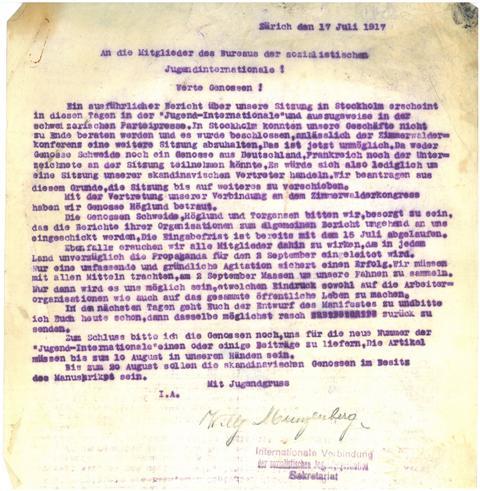
Read more about the program on the conference website.
If you are more interested in the early history of the Youth International, you may want to study ABA’s former research librarian Gerd Callesen’s presentation of relevant sources on our German sister archive’s page on the subject.
Others also read

THE STAUNING OF ALL OF DENMARK
Thorvald Stauning was a beacon in Danish politics and is the longest-serving prime minister of the 20th century

WITH THE LAW OR WITHOUT
In 1871, the living conditions for the few industrial workers in Denmark at the time were appalling. But when the labor..

THE BATTLE FOR TIME
Working 48 hours a week. It sounds like a lot for a Danish worker in 2019. But 100 years earlier, it was just..


