Search
The time leading up to the Second World War was filled with tension, both internally in Denmark and in Europe.
In the 1930s, Thorvald Stauning is not only the undisputed leader of the Social Democratic Party and the labor movement – he is the father of Denmark. The Social Democratic Party went from being a labor party to a people’s party that had the support of broad sections of the population.

Denmark for the people
In 1934, Stauning himself writes the Social Democratic Party’s work program Denmark for the People. It emphasizes the obvious and down-to-earth nature of the party’s politics and the desire to be a people’s party and not a class party. It is very cautious about putting nationalization on the political agenda – apart from the National Bank. Otherwise, nationalization or socialization is something to be considered first, but it must be through the path of parliamentary reforms. The emphasis is on control and planning, the promotion of employment, the cultivation of new markets, interest relief for agriculture and better wages and working conditions for workers.
The work program also redefines the Social Democratic position on the defense issue with more defense-friendly wishes, and the unrealistic nature of the previous desire for isolated disarmament is recognized. The Nazi seizure of power in Germany in 1933 was primarily responsible for this development in the Social Democratic Party. What is new in the work program is that the people’s party theme is rounded off and placed in a holistic view of Danish society, and that Social Democracy unambiguously proclaims itself as a national party for the people.
The work program Denmark for the People ends thus: “We are small people in Denmark, but there is will, courage and drive in the people, and this must also be seen in the political work. Up to the deed of the day. For home and children, for people and country. Denmark for the people.”
The struggle between Social Democracy and DKP
The contradictions between the Social Democratic Party and the DKP are significant in this period. In the 1920s, DKP leads a modest opposition to the Social Democratic leadership in the trade union movement. The number of positions of trust in the trade unions taken over by the Communists increased significantly in the 1930s, which led to the Social Democrats after the 1932 election, when the DKP won two seats in parliament, leading to a vigorous effort against the rise of the Communists among the workers. At the 6th Comintern Congress in 1928, the Social Democrats were identified as the Communists’ main tactical enemy.
According to the communists’ view of history, fascism will succumb of its own accord when capitalism leads to a profound crisis, which fascism will be powerless against. Therefore, DKP’s long-term policy is to weaken the Social Democrats so that they do not stand in the way when the capitalist system collapses. This is the reason why the Social Democrats systematically fight the communists through, among other things, the Central Organizations’ Information and Propaganda Department, HIPA.
HIPA’s purpose is to launch a powerful agitation against Nazis and Communists. From 1936, HIPA leads the ongoing written information service for the party’s shop stewards, reporting from the workplaces on the political mood and registering communist shop stewards. During this period, the DKP accuses the Social Democrats of class collaboration and of having lost the socialist objective.
Europe in the 1930s
While the 1930s were relatively calm politically in Denmark, there were dramatic developments in the countries of Europe. In 1922, the fascist leader Mussolini came to power in Italy. Mussolini is given unlimited power and takes the title “duce” (leader). In the early years, there is little opposition to his dictatorship. Gradually, Mussolini’s foreign policy becomes more and more imperialistic. Italy undertakes a significant military buildup and in 1935 Mussolini conquers Abyssinia.
In 1933, the National Socialists under the leadership of Adolf Hitler come to power in Germany. The German Reichstag grants Hitler absolute power and Hitler soon holds the title of “Führer” and Chancellor. A ruthless persecution of political opponents and Jews begins, freedom of speech and the press is abolished, the independence of the judiciary is abolished and all power is in Hitler’s hands. Austria is incorporated into Germany in 1938. Hitler demands that Bohemia in Czechoslovakia be united with Germany and in spring 1939 he dissolves the rest of Czechoslovakia. The German minority in North Schleswig eagerly agitates for the return of North Schleswig to Germany. Hitler makes deals and breaks treaties as soon as it suits him, the German army in the late 1930s is stronger than ever before.
Together with the two other dictatorships, Italy and Japan, Hitler forms a Berlin-Rome-Tokyo axis. The electoral victory of the Spanish Popular Front in 1936 unleashes a long-suppressed hatred and resentment among the Spanish fascists led by Franco and a three-year civil war breaks out. The three-year civil war is a terrifyingly bloody showdown between socialists, communists and republicans on one side and fascists and monarchists on the other.
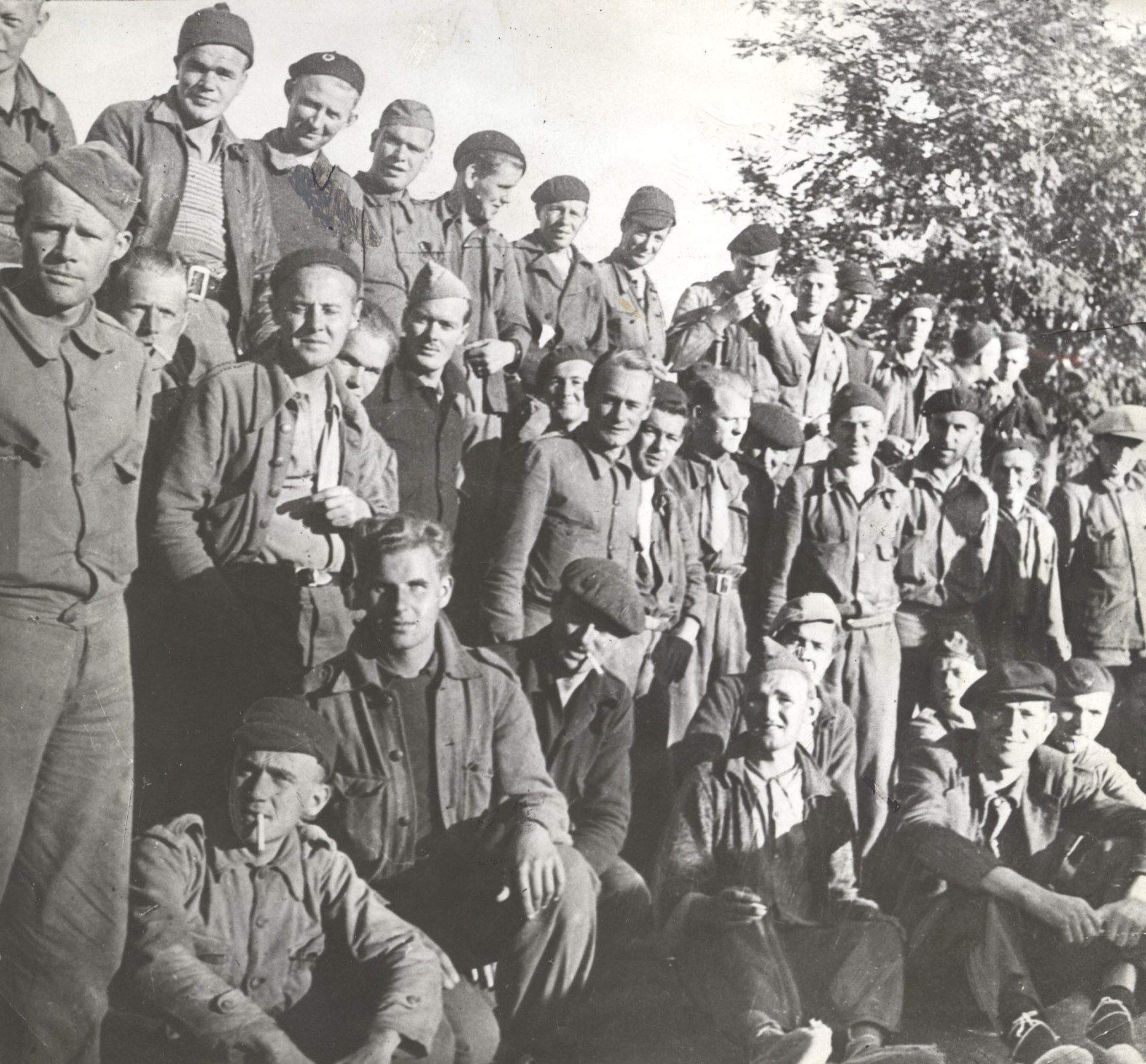
The Danish volunteers in Spain
Denmark, along with a number of other states, chose a policy of non-intervention in the civil war in Spain and thus did not support the legally elected Spanish government’s efforts to stay in power. This is despite the fact that the rebels, the fascists, receive help from Nazi Germany and Fascist Italy. The official justification is that what is happening in Spain is a civil war and therefore an internal matter. The real reason is probably that the government doesn’t dare take foreign policy actions that could provoke Germany.
Official Denmark still adheres to the policy of neutrality and wants to remain neutral in a possible future major war – just like during World War I. The Soviet Union decides to help the Republicans with weapons and advisors, and it is the communist parties that take care of recruitment for the International Brigade, which consists of socialists, communists and bourgeois liberals who volunteer to fight against fascism.
Approximately 550 young Danes from Denmark participate in the International Brigade, half of whom never return – the average lifespan of a soldier is 30 days. When the Danish volunteers from the Spanish Civil War return home, official Denmark does not do much for them. Several are taken to the police station for interrogation, and some are sentenced to imprisonment for their efforts against fascism, as a law against participation in the Spanish Civil War had been passed a few years earlier.