Search
The King summons the party leaders to a conference
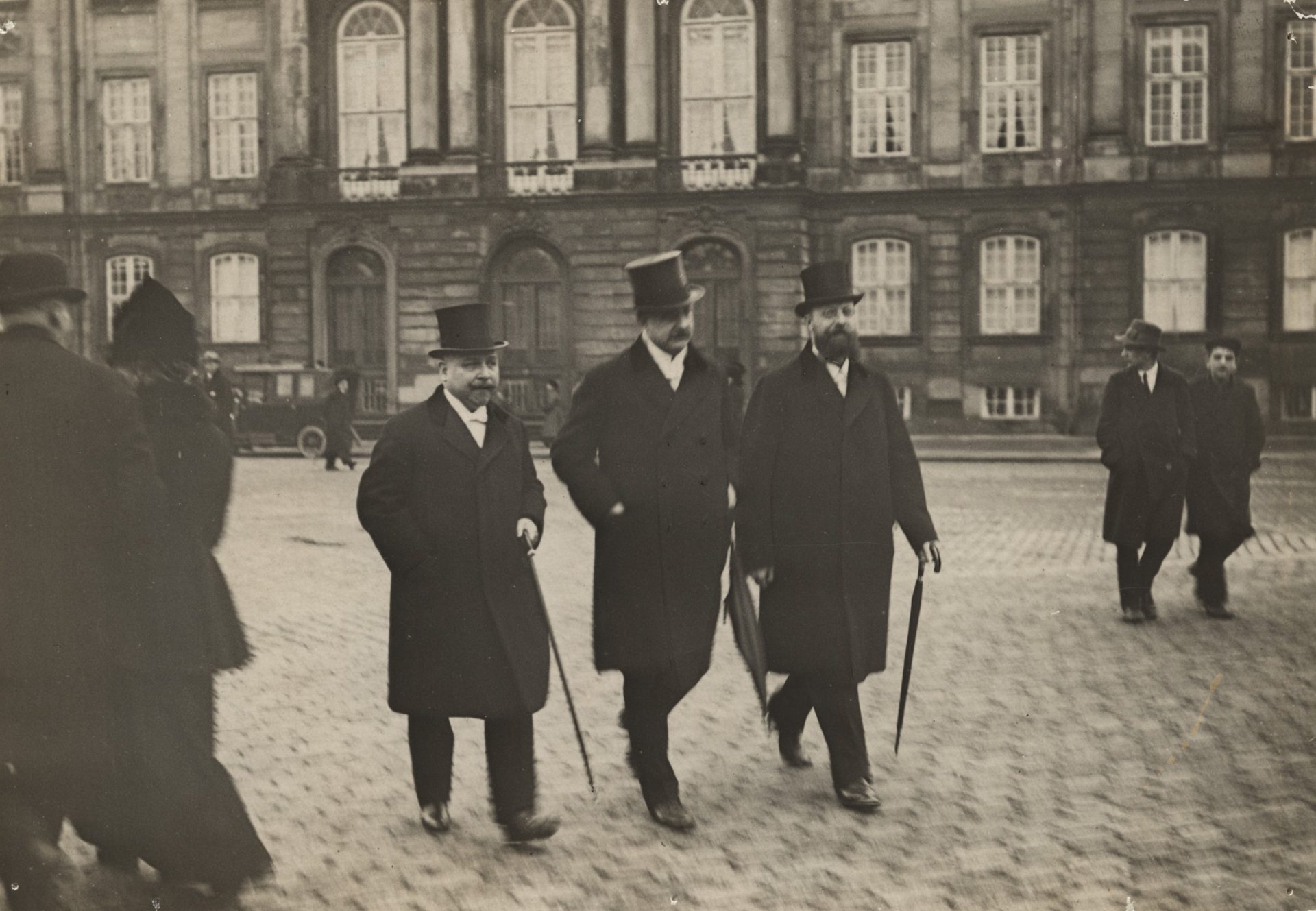
The delegation from the Parliament had barely left Amalienborg before the King summoned all party leaders in the Riksdag to a conference at 21:00. The King began the meeting by calling on the party leaders to agree on the situation, which Stauning interpreted to mean that the future of the Liebe Ministry was now up for negotiation and that the threat of a general strike could be used as a weapon to dismiss the Liebe Ministry.
The meeting did not go quietly. In particular, the exchanges between Liberal Party chairman I.C. Christensen and Stauning were loud. I.C. tried to disarm Stauning by not showing fear of a general strike and made it clear to Stauning that it would ultimately be the working class that would lose the battle if it came to a general strike. The threat of a general strike was real, as the Confederation of Trade Unions (DsF) was prepared to strike from 6 April, but the IC was aware that the trade unions outside the DsF, especially syndicalist movements, were difficult to control in a common front.
After a few hours of negotiations, the king, who was now really getting tender, was brought in, and as the first and contrary to the truth, the king told Liebe in private that all the party leaders wanted him to resign. In truth, it was still only the Social Democrats and the Radicals who had made this demand, but despite the king’s pressure on Liebe, Liebe continued to appeal to the king not to give in and, as a last call for help, summoned the government’s ministers in the hope of creating conditions to continue – but the end was near for Liebe.
The Easter crisis came to an end
It was three o’clock in the morning before the king bowed to the demand and dismissed the Liebe ministry. The Liberals and Conservatives regretted Liebe’s departure, but averting a general strike and the prospect of a general election was enough for the two parties to reach an agreement.
Stauning proposed M.P. Friis as prime minister in a future transitional government. Friis was appointed by the King, but as a condition of his appointment, he made it clear that the situation in the labor market was unsustainable and had to be resolved immediately. Parliamentarism was restored, the king’s political power was eliminated, and since the night between April 4 and 5 could bring a settlement between the trade union movement and the employers, the Social Democrat found reason to proclaim: “The most glorious victory in the history of our movement has been won”.
The trade union movement and Borgbjerg had contributed decisively to the development and ending of the Easter crisis, but although the extent is debatable, it seems beyond doubt that Stauning played a very special role. Early on, Stauning saw the value and necessity of adopting a negotiation-oriented approach to the other side’s views, while the trade union movement organized and prepared for a general strike. Stauning’s appearance, negotiating skills and trust-building relationship with the king must also be considered significant factors that ensured that the Easter crisis remained a parliamentary crisis and did not turn violent.
In the subsequent parliamentary elections held on April 26, the Liberal Party, the Conservative People’s Party and the Business Party were greatly strengthened with voter support of over 60%. The Liberal Party’s Niels Neergaard’s government lasted until 1924, when Stauning became Prime Minister.
See our photo gallery about the Easter crisis in our photo database