 Search
The small Maoist party, KAP, had its heyday in the 1970s. After the Cold War, the party has mainly been mentioned in the media in connection with the party and its members’ support for the Khemer Rouge in Kampuchea and the regime in Albania.
By Jesper Jørgensen
The archive
In connection with KAP’s closure, the party’s archive was transferred to ABA. In the fall of 1993, an agreement was made on the transfer of the party’s material. The archives consisted of congress material, minutes, correspondence, manuscripts for speeches, press releases, material from the party’s committee work, May Day, parliamentary and municipal elections, summer camps, etc. as well as flyers, leaflets, pamphlets, books, magazines, newspapers, posters, photographs and drawings.
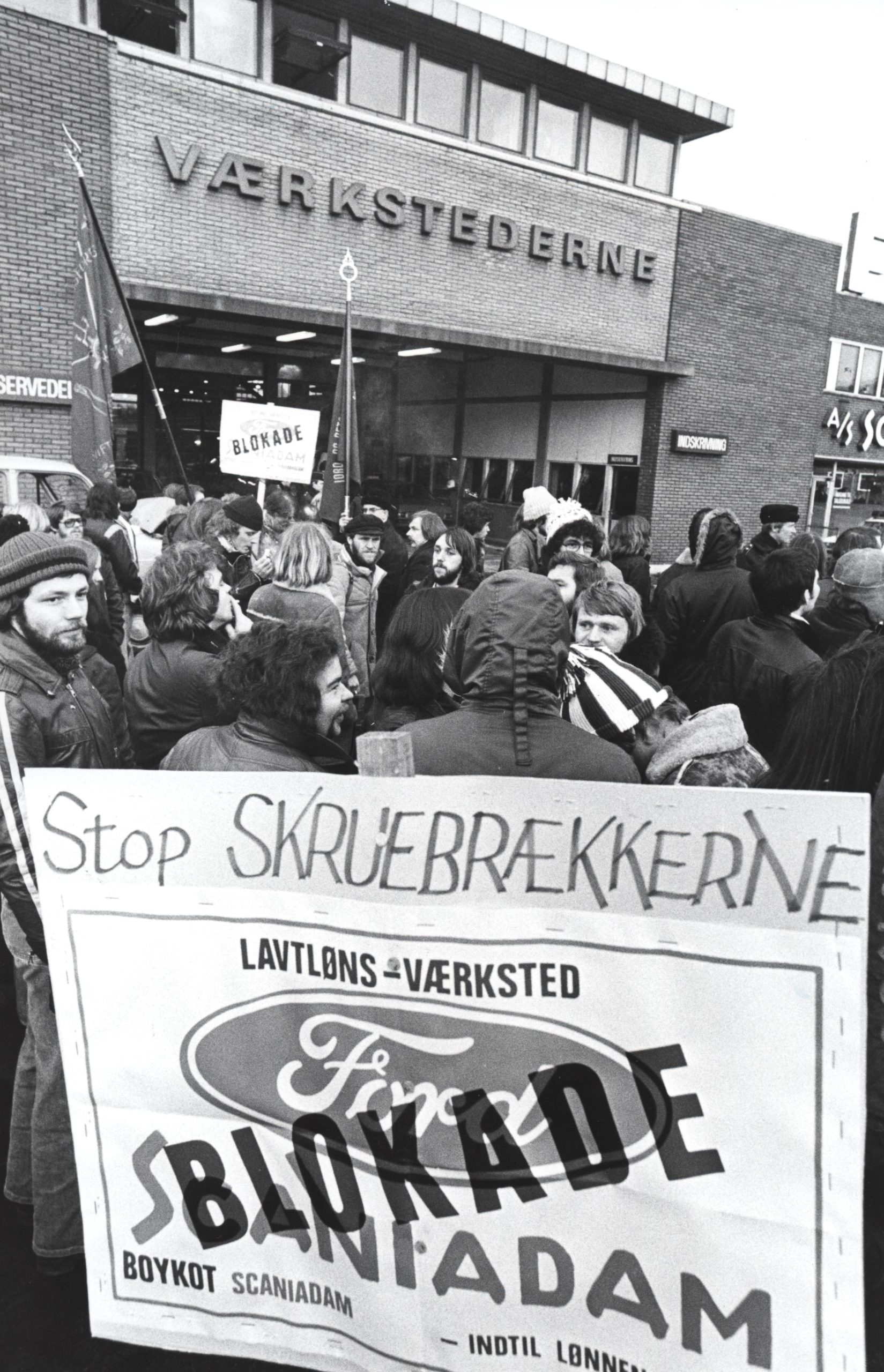
Following the arrangement at ABA, the archive consists of 47 boxes covering the entire lifetime of KFML/KAP from 1968 to 1994. See the archive here: Communist Labor Party Archive
Separated from the Communist Labor Party Archive are records from the Marxist Leninist Unity League, Communist Youth Marxist-Leninist, Communist Workers’ Youth, Friendship League Denmark-China and the weekly newspaper The Red Thread.
Outline of KAP’s history
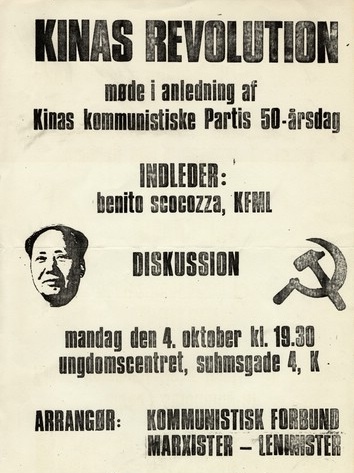
Formally, KAP was founded as a party in 1976. However, the party’s origins date back to September 15, 1968 in Folkets Hus, Rømersgade 22 in Copenhagen, where Benito Scocozza and Hans Henrik Nielsen from the Left Socialists’ leadership and about 30 others founded the Communist League (Marxist-Leninist) (KF(m-l)).
The current background was a split within VS and VS’s youth organization Socialist Youth Forum (SUF). The Maoists had become a minority in both organizations. SUF had been taken over by a Trotskyist wing in the summer of 1968. There was therefore a need for an organization that stood firm on a clear revolutionary standpoint, as Scocozza formulated it in his situation report at the founding general assembly. The purpose of KF(m-l) was, according to its principles, to prepare the formation of a revolutionary communist party (as opposed to DKP), based on scientific socialism: Marxism-Leninism, the thinking of Mao Tse-tung.
See e.g. their KFML national meetings
However, before the organization could take the lead in the struggle of the working class, there was a theoretical disagreement that had to be overcome. It was the question of Stalin. Was Stalin a great revolutionary with some serious flaws or was he as infallible as Lenin and Mao? The approximately 50 members did not agree, and at the end of 1970, the union had to reconstitute itself as the Communist Federation of Marxist-Leninists (KFML), now with approximately 13 members who did not consider Stalin to be completely infallible. The situation in the youth wing, Communist Youth Marxist-Leninist (KUML), was similarly critical. In 1971, the KUML was therefore disbanded in favor of the KFML.
See the archive here: Communist Youth Marxist-Leninist Archive

In the period 1972-75, the Maoists were particularly concerned with the relationship with the Revolutionary Housing Organization of Marxist-Leninists (BOm-l)/Marxist-Leninist Unity League (MLE). BOm-l, which had emerged out of a Maoist branch of the Slum Stormers, was initially prepared for closer cooperation with the YCL, but when it came down to it, they could not agree on a common basis. The break finally came in 1973, when BOm-l abandoned the collaboration and constituted itself as a federation (MLE). Instead of unity, the result was a rivalry that lasted until 1975, when the MLE gave up the oath. By 1974, several MLE members had already started to join the KFML.
See these archives here:
Marxist-Leninist Unity League Archives
Communist Labor Party Archives: Cases: Relations with BOm-l/MLE
During 1974-1975, KFML slowly changed from being a sectarian study circle to a political grouping that, in connection with several collective bargaining disputes, managed to get into the spotlight of both the trade union movement and the media. From 1975, KAP’s conflict-oriented, trade union work led to the launch of decided campaigns, so-called kineserhetz, against the “Chinese moles”.
The attention paid to KFML resulted, among other things, in the membership of the union increasing to several hundred and KFML was confirmed in its correct politics. On the agenda was therefore also the preparation of a rebuilt communist party in Denmark, which was gradually perceived as complete. On November 21, 1976, the Communist Workers’ Party was founded.
See the archive for the national meetings here: Communist Workers Party Archive: KAP’s national meetings
The period 1977-1979 would later prove to be KAP’s “heyday”. The party had now established itself with an actual party apparatus with its own bookstore, its own publishing house, which among other things published the daily newspaper Arbejderavisen and the journal KT: Kommunistisk Tidsskrift as well as rental business (Selskabet af 15. september 1968) – run by up to 1000 energetic members.
Borrow and view the following material:
Kommunist: KFML’s magazine (1968-1976)
Workers’ newspaper (1976-1991)
Communist magazine (1973-1982)
KT: Communist Journal (1982-1988)
Communist Workers Party Archive: Publishing and rental business
One of KAP’s first major tasks was to stand for the parliamentary elections in October 1979. Expectations were high. Among the activists, it was considered realistic to get over the threshold. However, the result of the election was quite different. KAP received 13,070 votes, which was less than half a percent of all votes.
Communist Labor Party Archive: Parliamentary elections
International relations
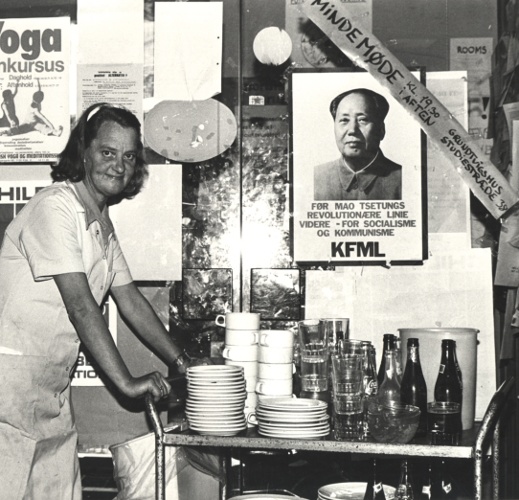
Just as quickly as the party had progressed, it went backwards again. With the death of Mao in 1976, the suppression of the democracy movement in 1979 and Deng Xiaoping’s return to power, changes occurred in China that were difficult to reconcile with KAP’s Maoist ideology. As it became increasingly clear that the Cultural Revolution had not been the realized socialist utopia that the “kaps” had hoped and wished for, a real identity crisis gradually emerged in and around the party. The support of previous years was crumbling.
The Denmark-China Friendship League Archives
Communist Labor Party Archives: Anti-Imperialist Secretariat/Foreign Policy Secretariat
Although KAP attempted to reorient itself in 1980 by focusing more on its own ideas of “socialism in Danish”, the 1980s and the first half of the 1990s became one long downturn. Internal disagreements and, not least, external political circumstances meant that in 1990 the party oriented itself towards the newly formed Enhedslisten, the red-green party consisting of VS, SAP and DKP. However, due to opposition from DKP, the actual inclusion of KAP was not realized until 1993. At the same time, KAP’s membership was so low that it no longer made sense to continue the party as an independent organization. KAP was finally dissolved on November 24, 1994.
Literature
Communist Workers’ Party (KAP), Encyclopedia for the 21st century (www.leksikon.org).
Ib Hørlyck: Scaniadam konflikten: Blokade mod skruebrækkere, Forlaget Oktober 1978.
For KAP’s relationship with Democratic Kampuchea, see:
Steen Andersen: Det danske vidne, Weekendavisen 7.9.2001.
Peter Frederiksen: Genocide with Danish connection, p.227-231 in Bent Blüdnikow (ed.): Opgøret om den kolde krig, Peter la Cours Forlag 2003.
For the fascination of Cultural Revolution China, see:
Erik Kjærgaard: The Inner Utopia. En socialpsykologisk diskursanalyse af danske rejseberetninger fra kulturrevolutionens Kina 1966-1976, unpublished thesis, Roskilde University Center 1999 (ABA).
For former KAPers’ relationship to their political past, see:
Peter Øvig Knudsen’s interviews in Weekendavisen 3.1.-14.2.2003.
Others also read

THE STAUNING OF ALL OF DENMARK
Thorvald Stauning was a beacon in Danish politics and is the longest-serving prime minister of the 20th century

WITH THE LAW OR WITHOUT
In 1871, the living conditions for the few industrial workers in Denmark at the time were appalling. But when the labor..

THE BATTLE FOR TIME
Working 48 hours a week. It sounds like a lot for a Danish worker in 2019. But 100 years ago, it was just..


