 Search
Anker Jørgensen’s terms as Prime Minister in 1972-73 and 1975-82 were marked by the economic crisis and political tug-of-war with both the trade unions and the rest of the left over issues such as the Economic Democracy project. Nevertheless, with his working-class background, he remains one of the most popular Social Democratic prime ministers.
Anker Henrik Jørgensen was born on July 13, 1922 in Copenhagen and died in the same place on March 20, 2016. He was orphaned at the age of 5 and grew up with his aunt and uncle in Christianshavn. He went to school at the Kgl. Vajsenhus.
As a young man, he worked at FDB’s warehouse on Islands Brygge. He served his military service during the Occupation, where he was also active in the resistance movement as the leader of a military group in which he organized weapons reception and distribution, among other things.
He became involved in union politics and became vice-president of the Warehouse and Warehouse Workers’ Union in 1950, and president of the same union from 1956-62. In the years 1956-63, he was also a teacher at the Social Democratic Labor School. He was also a member of the Copenhagen City Council 1961-64 and was elected to the Danish Parliament in 1964.
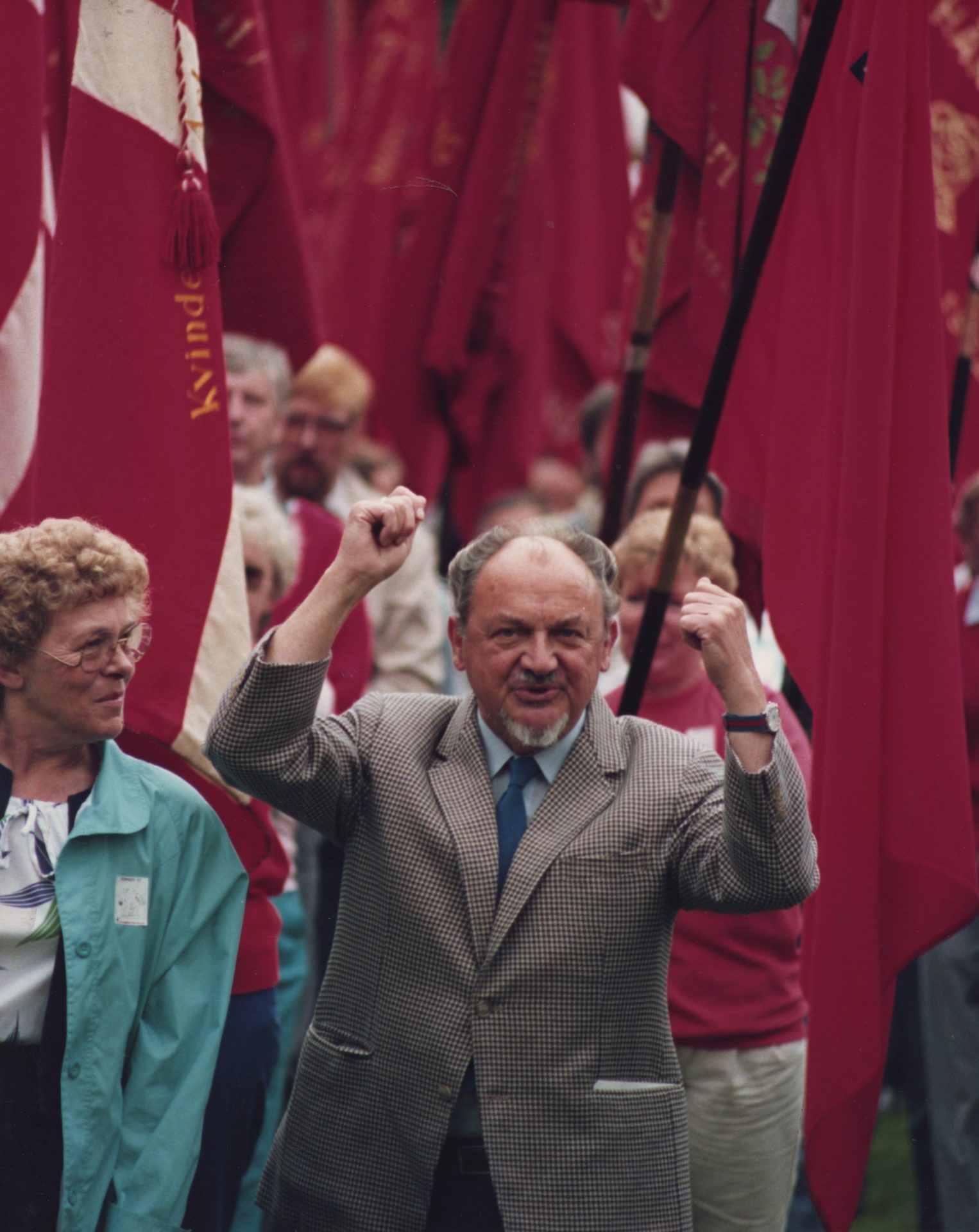
From 1962-68, Anker was business manager of the Danish Confederation of Labor and Specialized Workers before becoming chairman in 1968 – a position he held until 1972, when he replaced Jens Otto Krag as prime minister when Krag resigned after the EC referendum.
Anker Jørgensen was Prime Minister until the so-called landslide election on December 4, 1973, when the Liberal Party took power. In the January 1975 election, Anker Jørgensen and the Social Democrats regained power, and Anker served as Prime Minister until September 1982, when he handed over the prime ministership and government responsibility to Poul Schlüter and the Conservatives.
Anker Jørgensen continued as chairman of the Social Democratic Party until September 1987, and he sat in the Danish Parliament until 1994. From 1982-93 he was chairman of the Danish delegation to the Nordic Council.
Anker Jørgensen was Prime Minister during a period of economic crisis and upheaval in the party political landscape. During his reign, the Employees’ Holiday Fund was established and early retirement was introduced. In addition, the agreement on revenues from North Sea oil was renegotiated with A.P. Møller.
He fought a tough battle with both the trade union movement and the rest of the left over the failed projects, Economic Democracy (ØD) and Profit Sharing (OD).
IN ABA
Anker Jørgensen’s personal archive fills 340 boxes. The most extensive in the entire archive. the boxes contain correspondence, personal papers and manuscripts including speeches, articles and diaries. A significant part of the archive is made up of the so-called day sheets, which are dated paper covers. Diaries can contain all types of material and make it possible to follow Anker Jørgensen’s activities from day to day.
You can search Anker’s archive directly here:
Literature, photographs and posters:
Literature by Anker Jørgensen
Literature about Anker Jørgensen
Anker Jørgensen in ABA’s photo collection
Anker Jørgensen in the ABA’s poster collection


