 Search
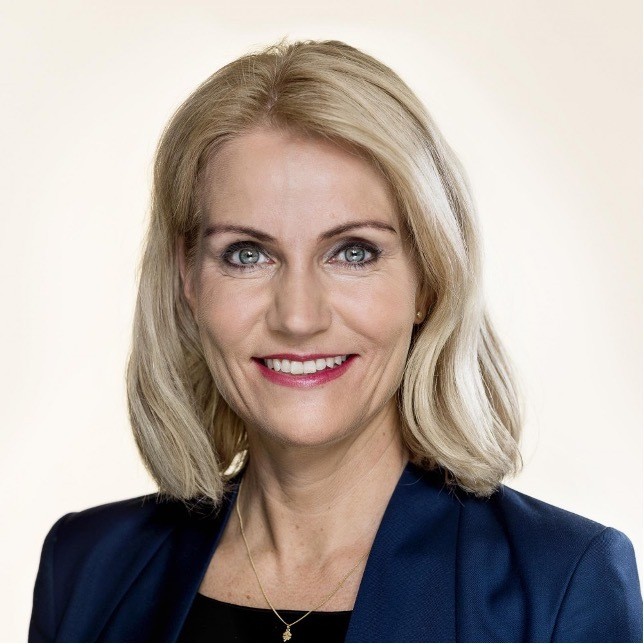
In a time marked by the aftermath of the financial crisis and an immigration policy where the Social Democratic Party had struggled to find its footing, Helle Thorning-Schmidt broke several Social Democratic electoral defeats and ten years of opposition, when she became Prime Minister of Denmark on October 3, 2011 under the campaign slogan “Fair Solution”.
Helle Thorning-Schmidt was born on December 14, 1966 in Rødovre and spent her childhood and adolescence in Ishøj, where she also received her upper secondary education in 1985. She is the daughter of former Head of Office Grete Thorning-Schmidt and former associate professor and cand.oecon. Holger Thorning-Schmidt. She is married to British-born Stephen Kinnock, with whom she has two daughters.
Helle Thorning-Schmidt graduated from the University of Copenhagen in 1994 with a Master of Science in Political Science and became head of the Social Democratic Party’s secretariat in the European Parliament the same year, before returning to Denmark in 1997 to become International Employment Consultant for LO. Helle Thorning-Schmidt worked here until 1999, when she was elected as a Member of the European Parliament for a five-year term.
When Mogens Lykketoft chose to step down as party chairman after his election defeat on February 8, 2005, Helle Thorning-Schmidt was elected new party chairman on April 12, 2005 after a run-off election with Frank Jensen. This made Helle Thorning-Schmidt the first woman to hold the chairmanship of the Social Democratic Party – a position she held until election night on June 18, 2015, when the Social Democrats lost power and Helle Thorning-Schmidt became Prime Minister to Lars Løkke Rasmussen.
a position she held until election night on June 18, 2015, when the Social Democrats lost power and Helle Thorning-Schmidt became Prime Minister to Lars Løkke Rasmussen.
Tax reform and division
Helle Thorning-Schmidt led Denmark through a challenging economic period and proclaimed early on that the government’s top priority was the continuation of the previous government’s economic growth policy with a focus on a balanced state budget, with financed public spending. In this way, Helle Thorning-Schmidt essentially continued the reform course and economic policy pursued by successive governments since the early 1980s, and on several occasions she showed herself willing to make decisions that went against parts of her parliamentary base. The tax reform of 2012 stands as a key example of the policies of that government period. With the reform, the government wanted to increase labor supply and employment by easing personal taxes and cutting transfer payments by a total of DKK 17 billion. The reform was adopted with the Liberal Party and the Conservative People’s Party, among others, but also created a split between the government and the Unity Party.
The Social Democrats, Socialist People’s Party (SF) and the Social Liberal Party formed the government until early 2004, when the SF chose to leave the government after internal discussions within the party about the government’s economic policy. The tax reform and the sale of parts of the state’s DONG shares, which was also a major topic of discussion during the period, played a crucial role in SF’s decision.
Fair solution
Although Helle Thorning-Schmidt’s governments tightened immigration policy to an extent that the governing parties could support internally, this highly political area, along with accusations of breaking promises, cf. the election program “Fair Solution” from 2011, was constantly challenged by the opposition throughout Helle Thorning-Schmidt’s government period and was also one of the main themes in the 2015 general election.
After more than 11 years as a member of parliament, including four years as Denmark’s first female prime minister, Helle Thorning-Schmidt chose to resign from parliament in connection with her appointment as director of Save the Children International in January 2016. Today, Helle Thorning-Schmidt works partly for Facebook and partly as chair of a UN panel that fights tax havens and corruption.
The Workers’ Museum & ABA has received the first part of Helle Thorning-Schmidt’s private archive, which is restricted/unavailable until January 1, 2046.
See other material about Helle Thorning-Schmidt in ABA.


