 Search
Expanding the Socialist People’s Party archive has been one of the archive’s priorities this fall. At the top of the list has been the National Trade Union Committee (FLU), which so far has only taken up a small part of the total party archive.
By Rasmus Ravnholdt Johnsen, student intern | 16.12.2015
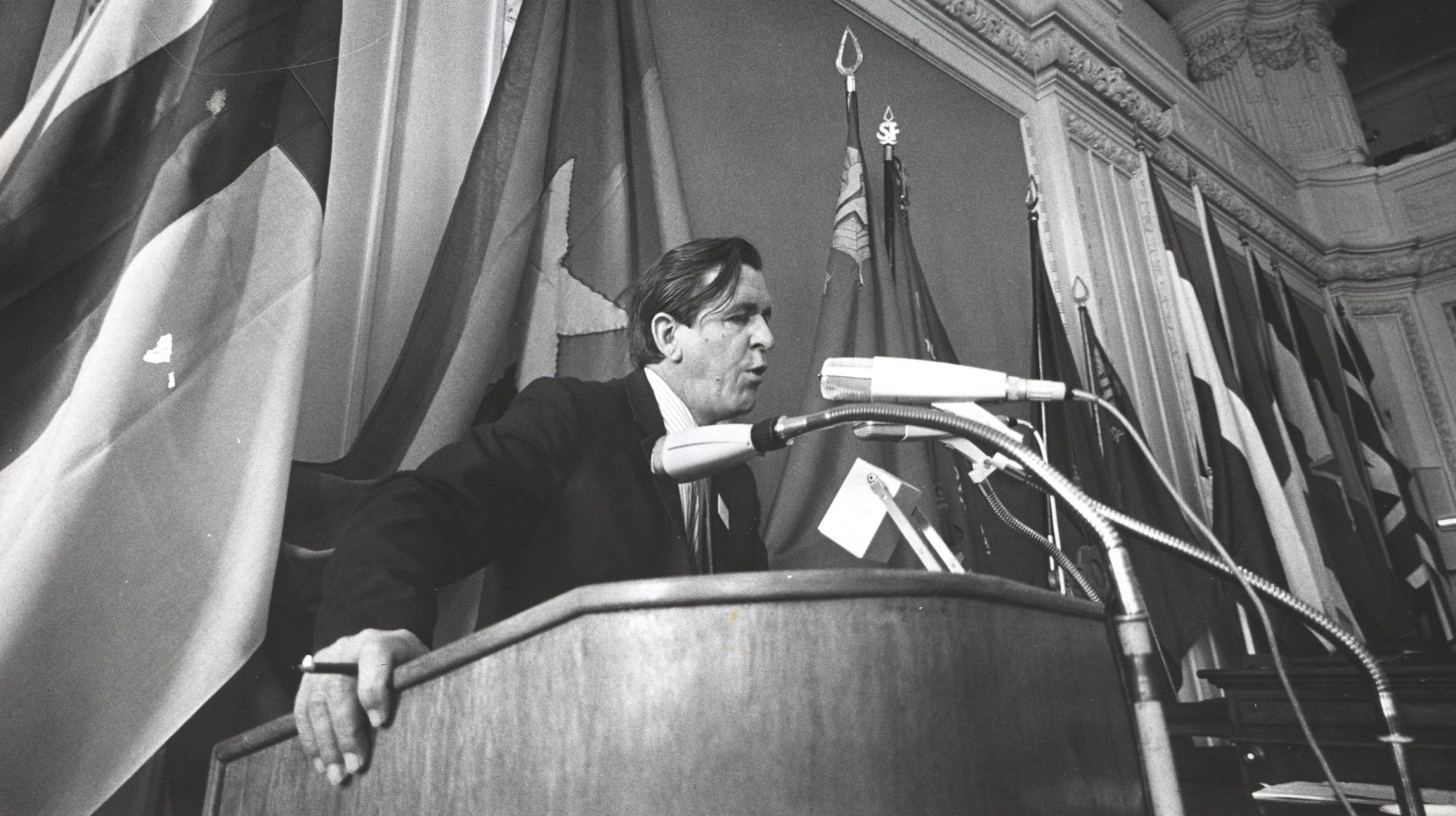
From the party’s founding and throughout the 1960s, FLU was appointed by the executive committee and approved by the main board. The committee’s tasks were to organize and spread the party’s trade union work, create contacts in the country’s workplaces and organize these into clubs. The dissemination of the party’s policy was to include the distribution of agitation material at workplaces. A national trade union conference was held every year, where the committee and participants discussed current issues such as collective bargaining. One of the big challenges in the 60s was to spread the committee’s work to the provinces.
The first 10-15 years were spent partly on an outward-looking process, where the party and the committee had to establish themselves in a changing political and professional environment, and partly on an inward-looking process. What should FLU become and what role should it play – in the trade union movement and in the party?
In 1972, the national trade union conferences were replaced by trade union delegate meetings, later national meetings. The committee would no longer be appointed by the party leadership, but elected by the conference delegates, who were union-active party members elected in the party associations. The trade union delegate meeting that year adopted SF’s first trade union program. Apart from the desire to recreate the trade union movement as a fighting organization, the criticism of the existing trade union movement was fairly subdued. In this way, it differed significantly from, for example, VS’ “union petrification”, and the program did not contain any analysis and criticism of the Social Democratic dominance in the trade union movement, as was the case with DKP’s trade union policy.
The material falls into two parts – one contains materials from the national conferences, later the national meetings, and other smaller trade union conferences, and the other part contains the ongoing work of the committee and the secretariat. The archive covers the period up to the end of the 1980s.
Other newly registered material
In addition to the FLU materials, this fall we have also registered archives from local SF party associations – Aarhus, Østerbro, Sundby 2, Svendborg and Rudkøbing. The archives cover the period from around the mid-1960s to the late 1980s. They provide insight into the party’s local work, ranging from small party associations with local characteristics to larger and influential party associations in Copenhagen and Aarhus. The archives paint a picture of some of the internal tensions that existed during this volatile period. This is particularly true of the Aarhus party association, which often stood for a different line than the “Copenhagen leadership”.
The work on digitizing the audio recordings of SF’s main board meetings, which began last year, has also continued. Read more about the work on digitizing the recordings.
Others also read

THE STAUNING OF ALL OF DENMARK
Thorvald Stauning was a beacon in Danish politics and is the longest-serving prime minister of the 20th century

WITH THE LAW OR WITHOUT
In 1871, the living conditions for the few industrial workers in Denmark at the time were appalling. But when the labor..

THE BATTLE FOR TIME
Working 48 hours a week. It sounds like a lot for a Danish worker in 2019. But 100 years earlier, it was just..


