 Search
The minutes from the SF Executive Committee meeting on February 24, 1969, state very briefly that: “As the present minute-taking system is not working satisfactorily, an attempt will be made to tape-record the next HB meeting”. We do not know what discussions, if any, preceded this decision, but the experiment was launched at the Executive Board meeting on August 30 the same year.
By Asbjørn Carbuhn Aae | 16.12.2014
The recordings from the August meeting are not complete, and there are no recordings from the meeting held later that year in November, but from 1970 onwards, tape recordings of the Executive Board’s business and debates became standard procedure for the meetings.
From 1975 onwards, SF has regularly submitted these recordings to the Labor Movement Archives and Library. In 2012 it was decided to digitize the collection, and the preliminary culmination of this project is now available, where the recordings from the years 1969 to 1982 are made available as digital audio files.
The SF depicted in the main board meetings is a young party that, in the years immediately following the resignation of its first chairman, Aksel Larsen, in 1968, was still struggling to find its feet and a firm position on the Danish left – sandwiched between DKP and VS on the left and Social Democracy on the right.
At the same time, the party had to struggle internally to clarify its relationship to the former chairman’s political legacy, the so-called “Larsenism”, according to which SF’s role under the current conditions was to strive for a “workers’ majority” in the Danish Parliament and thus pull the Social Democratic Party to the left. SF could not and should not challenge the Social Democratic Party as the dominant force in the Danish labor movement.
Larsen’s successor as chairman, Sigurd Ømann, continued the Larsenist line, but attempts to pull the large labor party to the left through parliamentary work had extremely poor political results, and Ømann resigned as chairman in 1974 as a consequence of the “landslide election” in December 1973, which resulted in a disaster for SF, and disagreements over the political line.
The debates during this period were dominated by the issue of EC resistance, which could unite the party, and the issues of nuclear power and possible revolutionary upheavals, which conversely provoked division. SF’s new chairman, Gert Petersen, had as one of his main tasks to navigate between Larsen’s old comrades, who had long dominated the parliamentary group, and the new generation of more radical red-green SFers. This showdown resulted in a slow phasing out of the veterans, tentatively culminating in the 22-hour main board meeting on November 7, 1976.
The last part of the period covered by the recordings tells the story of the creation of the new party program adopted in 1980 and the electoral triumph in December 1981, when SF went from 11 to 21 seats in the Danish Parliament.
All in all, these recordings constitute a vital piece of Danish history that depicts the left wing and Danish politics in a time of upheaval. The collection is not quite complete, but with over 700 hours of recordings in total, it still contains a wealth of stories.
The audio files are linked to the electronic registry of SF’s archive in ABA’s library and archive system, see for example Executive Board Meetings 1970.
Access to the recordings can be applied for via the archive records, and they can be listened to in the ABA reading room when permission is granted.
New audio recordings from SF’s main board meetings
By Liv Øvlisen Brun Jensen, student intern | 23.1.2017
In 1969, SF’s executive committee decided that future executive board meetings would be recorded, and since 1975, SF has continuously handed over the recordings to the Labor Movement’s Library and Archives. In 2012 it was decided to digitize this collection, and in 2014 the recordings from the years 1969-1982 became available as digital audio files. The second stage of the project has just been completed and the recordings up to and including 1989 are now also available.
The years covered by the recordings are paradoxical for SF. Poul Schlüter’s takeover of the Prime Minister’s Office meant that the party was largely without real political power, but at the same time it had the highest voter support ever. Membership rose from 5,600 in 1982 to 9,126 in 1988, and throughout the period SF was one of the country’s four largest parties with over 20 seats. In 1987, the party won 27 seats in the Danish Parliament, the highest number ever.
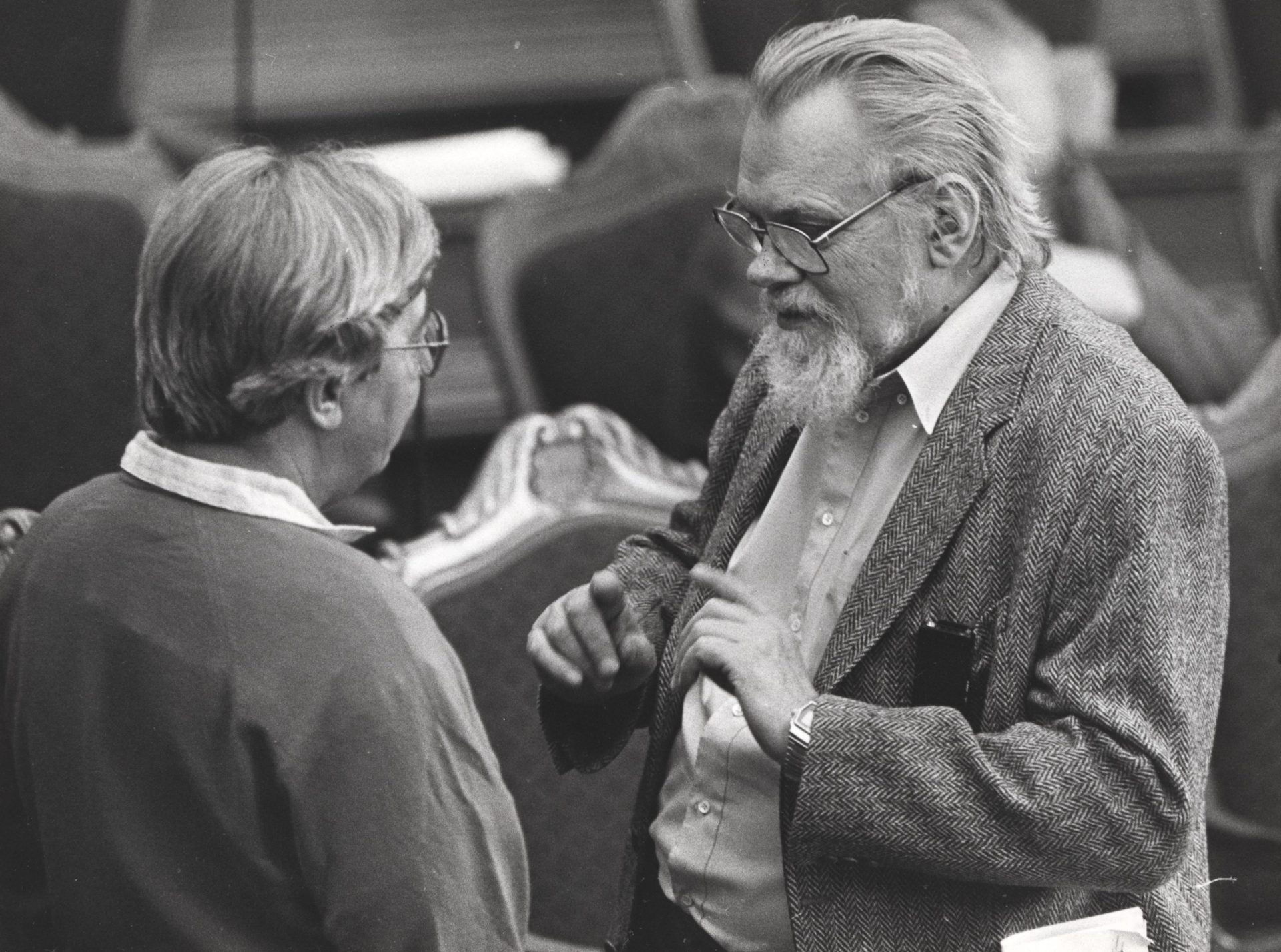
One of the areas where SF did make its mark was in security policy. SF was a permanent part of the alternative security policy majority together with the Social Democrats, the Radicals and for a period VS and the implementation of the so-called footnote policy. The alternative majority was broken after the 1988 election when Schlüter and the Conservative People’s Party dropped the Center Democrats and the Christian People’s Party, and instead took the Radical Party into government.
A major theme of SF’s main board meetings in the 1980s was the labor majority. After two failed attempts in the 1960s and 1970s, the Executive Committee in 1983 resumed the idea of a workers’ majority with the Social Democrats, and for Chairman Gert Petersen it was a matter of the heart. The Social Democrats were initially reluctant, but when the 1987 election revealed a majority against the right-wing government – which did not lead to a change of government as the smaller left-wing parties ended up below the threshold – negotiations began in earnest and a study group was set up. To the chagrin of the SF, this did not lead to many concrete results, as the Social Democrats focused more on negotiating with the government.
Another topic that recurs in the recordings for almost the entire period is magazine publishing. Despite the large increase in membership, SF still had a relatively small number of members compared to the number of voters, and in 1986 they were forced to close the Socialistisk Dagblad due to a lack of subscribers. Instead, the weekly newspaper Socialistisk Weekend was established, but it too struggled financially and closed in 1990.
In the latter part of the period covered by the footage, SF lost support and was criticized for not having much political influence despite its many seats. Both in the press and within the party, there was talk of a crisis, although this was denied by Gert Petersen.
Despite a few gaps, the recordings are an important source of SF’s heyday and of Denmark’s political history.
The recordings are linked to the electronic registry of SF’s archive in the library and archive system, and can be accessed via the archive records. See e.g. Executive Board Meetings January-May 1986. Once permission has been granted, the recordings can be listened to in the archive reading room in Rømersgade.
Others also read

THE STAUNING OF ALL OF DENMARK
Thorvald Stauning was a beacon in Danish politics and is the longest-serving prime minister of the 20th century

WITH THE LAW OR WITHOUT
In 1871, the living conditions for the few industrial workers in Denmark at the time were appalling. But when the labor..

THE BATTLE FOR TIME
Working 48 hours a week. It sounds like a lot for a Danish worker in 2019. But 100 years ago, it was just..


