 Search
By Torsten Lange | 01.01.1998 (First published in Årsskrift 1997, ABA 1998)
In the fall of 1997, ABA was able to declare DKP’s archive open for research. The archive, which covers the activities of the Danish communists through 70 years, was now so complete that access for researchers was justifiable. What remains is the final completion of the register for the archive, which comprises approximately 1400 archive boxes.
The story behind the handover
In an article from 1991, archivist Hans Uwe Petersen described DKP’s decision to hand over the archive, the agreement with ABA and the process of the handover, and gave an initial overview of the archive. Hans Uwe Petersen was also responsible for the first arrangement of a large part of the archive material in the early 1990’s. After this, the arrangement had to be put on hold until the undersigned, from late summer 1996 to fall 1997, had the opportunity to continue working on the arrangement of the archive.
DKP’s archive – an overview
DKP’s archive consists mainly of papers from the party’s house in Dronningens Tværgade. These consisted partly of ‘the working party’s’ materials: papers from the shelves, drawers and desks of the party employees at the time, and partly of the documents stored over time in the party’s ‘own archive’. In addition to this, there have later been handovers from and by members of DKP. In addition, the archive consists of 12 boxes of DKP materials that ABA has collected over time. A significant contribution to the archive is the microfilmed records that have come to ABA from archives in Moscow, primarily from the Comintern archive. These films include important documents about the relationship between DKP and the Comintern 1919-1941 and about the left opposition in Denmark from 1916 onwards. In the future, you should continue to be aware of the opportunities that the former Soviet archives in particular offer for sources on DKP’s history.
Three time periods
The DKP archive is divided into three periods: the period up to June 22, 1941. This part of the archive consists of approximately 40 boxes. It is a reconstructed archive, consisting of material collected by DKP and ABA.
DKP’s actual archive material for the period must largely be assumed to have been lost or destroyed through the authorities’ seizure of material and the party leadership’s own measures in connection with the party’s illegalization in 1941. This part of the archive contains material from DKP’s predecessors, especially the Socialist Youth League, whose active majority left the Social Democratic Party in 1919 and took the initiative to form the Left Socialist, later Communist Party, as well as party records from the 1920s and 1930s, which together indicate DKP’s increased political influence throughout the 1930s.
This section also includes documents from the Revolutionary Trade Union Opposition (RPO), from anti-fascist auxiliary committees and from other organizations close to the DKP.
DKP in illegality and resistance June 1941 – May 1945 contains approximately 15 boxes. It contains a collection of DKP circulars, flyers and other publications from the occupation period – printed material, as actual internal, systematically archived organizational material (meeting minutes, accounts, minutes, correspondence, etc.) for unexplained reasons is not found or preserved.
The late Børge Houmann’s papers, which have been handed over to the Royal Library, contain valuable pieces of the puzzle ‘DKP during the occupation’, about communist publishing and press work, etc. However, nothing definitive can be said until the collection is organized and registered.
DKP in the post-war period, May 1945 to today. This section makes up by far the largest part of the archive with around 1300 boxes. This is a comprehensive handover from a working political party.
The arrangement of the material
The registrant and arrangement must reflect DKP’s structure as a national organization with congresses, national meetings, central committee meetings and party conferences as the competent assemblies. It continues with the testimonies from the daily party management: executive committee, party secretariat, chairman’s office and secretariat for, among other things, trade union work, international relations and peace and solidarity work.
In addition, there is a very extensive and interesting section, namely the committees under the Central Committee, which helped develop DKP’s policy in a wide range of important areas.
Finally, there are several boxes with papers on the party’s political training and education activities that were of great importance for clarification and unity in DKP.
Finally, various topics and individual cases are listed separately for the sake of clarity, including leaflets, flyers and press releases; parliamentary elections and related election secretariats; papers left behind by the parliamentary groups; international communist conferences, meetings and trips; DKP’s celebration of political anniversaries (March 8, May 1, May 4, November 7), party anniversaries and more.
DKP’s archive contains a large collection of audiotapes and films. As early as the 1960s, the party’s central committee began recording its meetings on tape. The same goes for congresses, conferences and various national meetings. It takes time to work your way through these hour-long recordings, but you will certainly get an interesting impression of the discussions in the party leadership.
In addition, there are reels of various films dating back to the 1930s and beyond. In an article, Stine Korst has described this exciting material, some of which has been used in her new film about her grandfather, Martin Andersen Nexø. Unfortunately, only a few films are available to regular users at the moment.
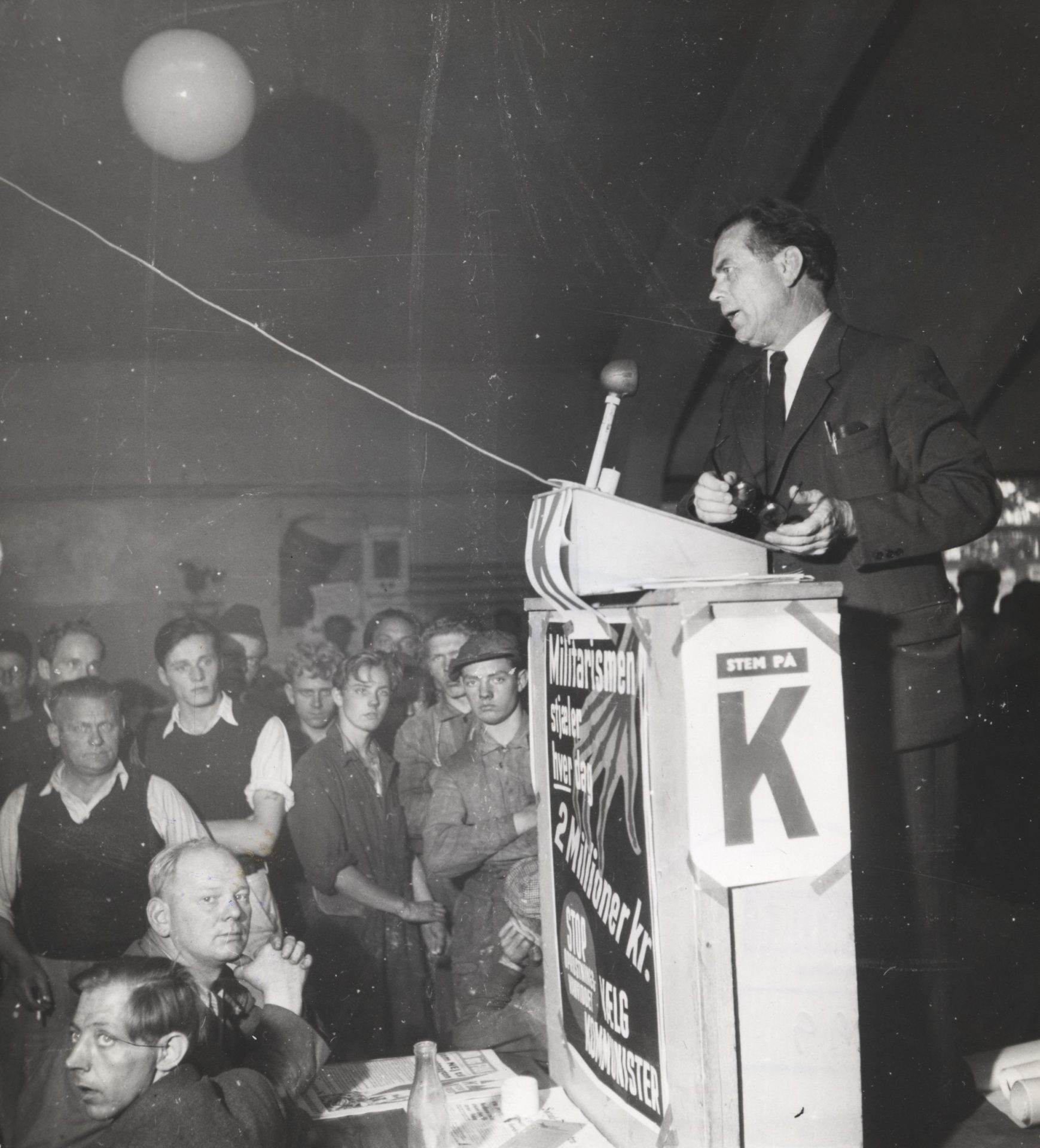
Certain types of material from DKP have been transferred to ABA’s respective special collections. This includes over 50 banners, many posters and all kinds of photographs, slides and other types of images and effects.
Other archives in the DKP national organization’s handover
With the large delivery of materials from DKP’s property in Dronningens Tværgade came a comprehensive material that can be divided into four main groups:
a. local DKP organizations
b. personal archives
c. independent economic units under DKP’s leadership
d. other political and cultural organizations associated with DKP.
Under a. falls first and foremost the large deposits from DKP Copenhagen (Copenhagen leadership and some districts) and Copenhagen County (the county leadership that was started in the 1970s). In recent years, ABA has also received archives from several DKP districts and branches, mainly in the metropolitan area and North Zealand.
Under b. you will find papers from DKP functionaries that were included in the large delivery, as well as material received from individual members and their families: party chairman Knud Jespersen; functionaries Ib Nørlund, Alfred Jensen and Ragnhild Andersen; Gelius Lund and doctor Ejnar Kruse, Odense. In addition, a number of scattered materials have been found with connections to other party members. ABA is still interested in hearing from people who can provide archives of living or deceased DKP members.
Under c. can be mentioned a number of companies under DKP’s leadership, such as Ejendomsselskabet af 25. september 1945, Folkepressen AMBA (including Dagbladet Land og Folk and Terpo Tryk) and Tidens Boghandel. The editorial material from Land og Folk is largely missing as the newspaper moved to Dronningens Tværgade 3 shortly before its closure. While the newspaper’s valuable image archive was secured by ABA, the rest of the editorial archive has been dispersed or lost. However, ABA has received scattered materials from Land og Folk after a few employees at the magazine.
Under d. you will find collections of primarily printed materials from friendship associations, including Landsforeningen Danmark-Sovjetunionen and Venskabsforeningen Danmark-DDR, from peace and solidarity organizations, including Atomkampagnen, Samarbejdskomiteen for Fred og Sikkerhed (with material from the World Peace Council) and Vietnam 69. There is also a lot of material on the history and organization of the EC resistance in 1970s Denmark, not least on the People’s Movement against the EC. An actual archive exists for the Danish Committee for the Baltic Sea Conference, which since the 1950s participated in trade union conferences between East and West and organized delegation and holiday trips for Danish trade union members to the GDR. Finally, DKP’s archive materials from 1989 onwards document the formation and development of the Unity List. The reason we find this material about other organizations at DKP is simply that leading party officials participated in the work of these organizations, or in some cases the archives of defunct organizations have been stored in the DKP building.
Are there gaps?
An archive will always to a greater or lesser extent be a fragment of its creator’s activities. There can be several reasons for this. In DKP’s case, there are several reasons for the gaps in the material rows. Firstly, the losses inflicted on the party from the outside. This is especially true for the papers before 1941, but probably also material from the occupation period. Also, the 1958 party showdown apparently affected the inventories in the party house.
In addition, the party’s own practice for discarding and archiving. At times, the party leadership has, for security reasons or as a matter of routine, destroyed material or deposited it outside the party building. If the latter is the case, missing minutes etc. may of course turn up along the way. In addition, individual DKP employees may have had different views on what it was necessary to store for posterity. If the party has not had a clear archive policy, or if it has not always been followed, this has naturally opened up the possibility of messy and poor storage of materials from individual offices.
Having said that, it is important to emphasize that DKP’s archive is a rich archive. Research into the history of DKP and the Danish labor movement will be able to find a lot of new information in the archive, not least about the period after 1945.
Researchers and students will be able to draw nuanced portraits of politicians such as Knud Jespersen and Ib Nørlund. The party’s dramatic rise in 1945 and subsequent rapid stagnation and isolation with the onset of the Cold War could be the subject of a study. The party showdown after Hungary 1956 and up to the break with Aksel Larsen could add new knowledge. DKP’s influence and positions in the trade union movement in the post-war period could be written on a better basis. As the latest history of Denmark after 1960 is being written, the same applies to the party’s recovery and renewed parliamentary breakthrough in the early 1970s, its initiatives and position in peace work, etc. There are still many hidden gems for the interested and the seeker!
Who can use the DKP archive?
DKP still exists, and according to the agreement with the ABA, the party regularly submits material to the ABA. No agreements have been made with the Communist Party of Denmark, KPiD. However, ABA hopes that both parties are aware of the possibility of involving ABA in connection with the storage of material left behind by deceased party members. This could, among other things, document the party work at department level.
DKP’s archive is open for research use, but you must apply for access. Written applications with an explanation of the purpose of using the archive should be sent to ABA, who will consider the applications on a daily basis. Until a final registrar is finalized, ABA will advise on material based on wishes and needs.
Others also read

THE STAUNING OF ALL OF DENMARK
Thorvald Stauning was a beacon in Danish politics and is the longest-serving prime minister in the 20th century

WITH THE LAW OR WITHOUT
In 1871, the living conditions for the few industrial workers in Denmark at the time were appalling. But when the labor..

THE BATTLE FOR TIME
Working 48 hours a week. It sounds like a lot for a Danish worker in 2019. But 100 years earlier, it was just..


