 Search
By Hans Uwe Petersen | 01.01.1991
It is hardly a secret that the Danish Communist Party has been greatly affected by the changes in Eastern European countries and the collapse of “realized socialism”. The breakdown created both discussions and divisions in DKP. But despite the disputes, the Central Committee at the time, which otherwise disagreed on most issues, decided in April 1989 to hand over the party’s archives to the ABA in full agreement.
Regardless of the background, DKP’s decision – from the ABA’s point of view – has great cultural significance. On the one hand, it created the basis for building an actual DKP archive, and on the other hand, ABA now has the archives of the decisive political currents within the Danish labor movement.
The prehistory
in DKP’s self-understanding, history in general and the history of the labor movement and the party in particular has always played an important role. The party’s general activities, its programs and publications, and not least its education and training activities are clear evidence of this. This is why DKP has taken several steps to build up an actual party archive.
After the liberation, Walter Thierry, among others, collected and organized some of DKP’s archives. Later, Tage Revsgaard Andersen worked on the issue for a number of years. In the early 80s, another, and this time organizationally more comprehensive attempt was made. The efforts made over the years resulted in the preparation of some registers of preserved records. There was also an extensive collection of important, primarily printed material about DKP and the resistance struggle. The party publishers’ pamphlets and printed matter were also collected and organized. Finally, some material was obtained from Soviet and GDR archives, as well as archives that had been removed from the party office in connection with the occupation and the demonstrations against DKP in connection with the Soviet attack on Hungary in 1956.
However, despite the efforts of these and other people, it was never possible to establish a proper and well-functioning party archive. This may seem surprising and give rise to considerations about the reasons for this. However, answering this question is not the subject of this article and should instead be referred to possible future studies.
In December 1987, in response to both pronounced dissatisfaction with the conditions surrounding DKP’s archives and the renewed intensive historical discussions within the communist parties, a group of younger historians who were members of DKP urged the party leadership to do something about the archive situation. The reaction was positive, and the party leadership encouraged the initiators to make more concrete proposals.
In February 1988, ABA presented some ideas for a possible transfer of DKP’s archive to the archive. Even though the further processing of the matter was delayed by the other discussions in DKP, a decisive breakthrough was quickly made for the idea of handing over the material to ABA, rather than making another attempt to build an archive under the auspices of DKP. This was not only due to the realization that handing over the material to ABA was the most realistic option for building an actual DKP archive. It was also because the discussions between ABA and DKP could overcome some of the more traditional reservations that existed in the party leadership towards ABA, its position and professional competence. In this way, the basis for the central committee’s decision to transfer all existing archive material to the ABA was created.
However, the purpose was not only pragmatic in order to secure DKP’s archives. Crucial was also the desire to create the conditions for making this material publicly accessible.
DKP’s decision
The Central Committee’s overall decision on the party archive stated: “The preservation of tradition, the acquisition and dissemination of knowledge, which in itself is not static, but changeable based on new problems raised by historical development, requires that the archives are preserved, collected, registered and made accessible”.
At the same time, the then party leadership also approved an agreement between the ABA and DKP on the basis for the delivery of the material and a set of guidelines for access to DKP’s archive in the ABA.
The agreement between DKP and ABA emphasized that the transfer included all printed and non-printed, written and non-written records that were older than ten years at the time of transfer. In addition, the further collection of material from the party organization and the repatriation of DKP material to the Comintern archives were listed as future tasks
authorization.
When the ABA began packing the material in Dr. Tværgade in June 1989, it turned out that the decisions made were also supported in practice by both the party leadership and party office officials. A telling expression of this was, for example, that shortly before his death, Ib Nørlund called for his office to be emptied and for this material, which alone amounted to just over 50 shelf meters, to be immediately included in the total delivery. Those who resigned from their positions as party officials as a result of the decisions at DKP’s two congresses in 1990 also did their part to procure existing archives in the countless nooks and crannies in Land og Folks hus.
Alongside the transfer from DKP, ABA also entered into agreements with the Danish Communist Youth and the Danish Communist Students, KOMM.S. about their archives. Unlike DKP’s, once this material has been organized, it will essentially be freely accessible.
The scope of the handover
But even though the main purpose of the handover was and is to make the material accessible, both the scope of the handover and the condition of the material means that this goal can only be achieved little by little as the sorting and registration progresses.
The handover was essentially carried out in two stages. The first, comprising 410 boxes, took place during the summer of 1989, while the second took place in connection with the move from Dr. Tværgade a year later. As a result of this move from Land og Folks hus, the total delivery was also more extensive than anticipated. So far, a total of around 800 boxes have been delivered. DKU’s share of this is around 150, while KOMM.S. has contributed around 50 boxes. The total delivery also includes material that ABA has received from communists in Southern Jutland, DKU and KOMM.S. in Aarhus and a few other local party and youth branches, as well as individuals, as a result of the agreements made with the national organizations. More such submissions are on the way. Just as importantly, Gertrud Stjernholm Nielsen could be persuaded to hand over the material that Ib Nørlund had in their shared home in Bellahøj. This amounted to almost 90 moving boxes.
The contents
Although it is not yet possible to give a definitive assessment of the material received, it can be said that ABA has received an extremely valuable and in many ways unique collection, which – when completed – will constitute a central archive for studies not only of the Danish communist movement, but also of aspects of the history and development of the international communist movement.
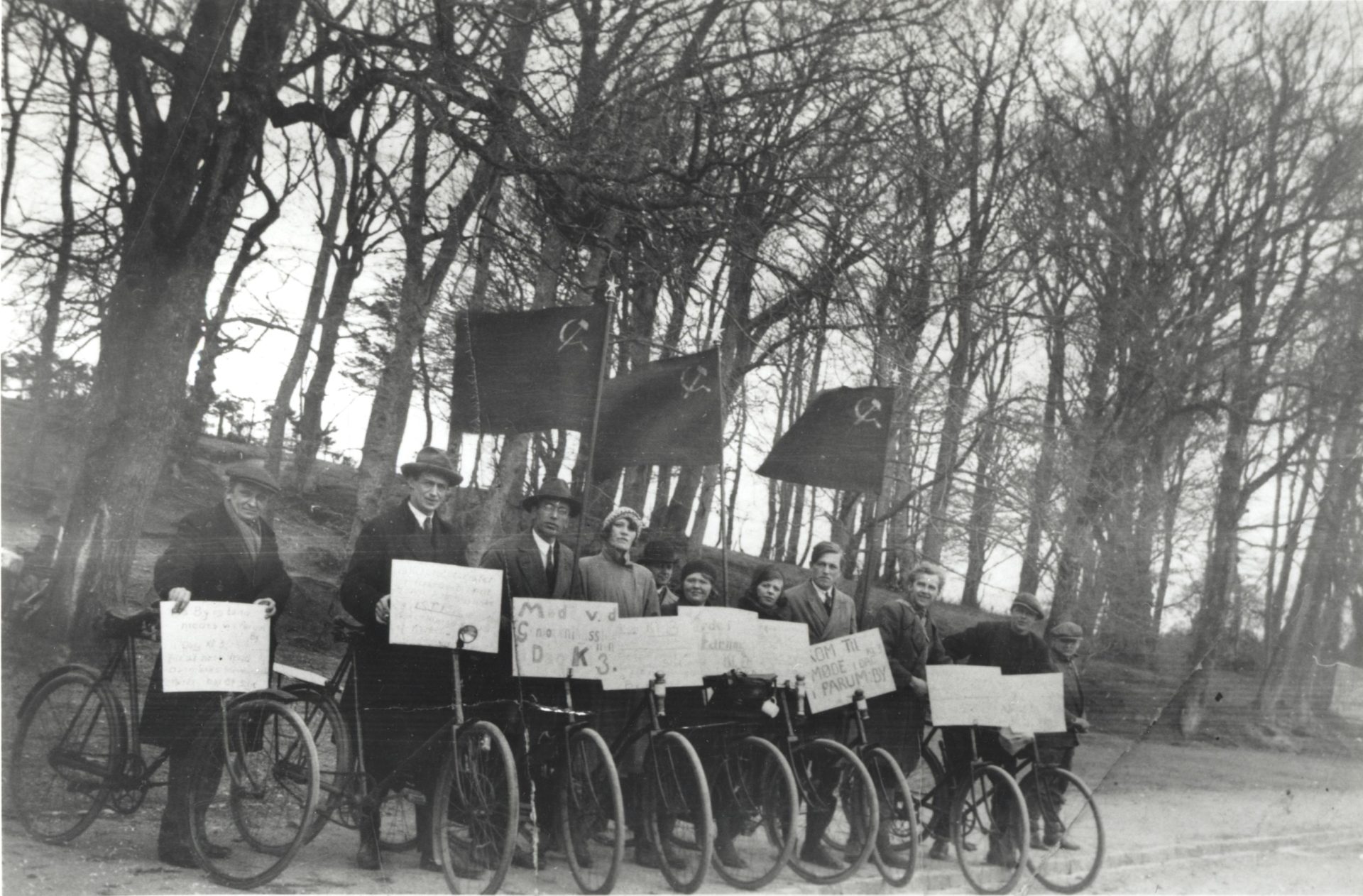
In addition to actual archive material, DKP’s deposit includes DKP printed matter (journals, pamphlets, books, posters), printed matter from other – especially communist – parties, organizations and institutions, Danish and foreign books, including some important and rare political literature from before 1945, photographs, films, video and audio tapes and banners.
In addition, there is material from Land og Folk. These are primarily bound editions of both Land og Folk and Arbejderbladet, various books and the newspaper’s biographical newspaper clippings collection, which is both extensive and valuable.
As can be seen from this summary overview of the material received, the delivery affects
not only the archive, but all departments of the ABA. The handover from DKU, which also includes more than archival material in the narrow sense, consists in a way of two parts. Firstly, a partially organized archive that mainly concerns the prehistory and development of the youth union until the early 1970s. Secondly, there is unorganized material from the subsequent period and up to the closure of DKU.
KOMM.S.’ submission includes material from the entire life of the national organization (1974-1990) and from the local chapters, including KOMM.S. in Aarhus, which was already formed in 1968.
DKP’s (and also DKU’s) archive material is not only material of communist provenance. The handover also includes archives from the Social Democratic Youth League (SUF), Mondes Forlag and from numerous organizations that Danish communists have worked in. These include the Danish Freedom Council, friendship associations, peace and solidarity organizations, including a large collection from Vietnam 69 and, not surprisingly, from the People’s Movement against the EC and its predecessors.
Although the collection – as mentioned – includes material from before 1919, the majority originates from the period after 1945. Somewhat surprisingly, it seems that there is actually more material from the 1920s than the 1930s. A significant supplement to this is a number of microfilms of material from the Comintern archives that have been obtained in recent years, which only emphasizes the importance of systematically repatriating DKP material from the Soviet Union.
The material includes minutes and supporting material from congresses, national meetings and conferences, from Central Committee, Executive Committee and Secretariat meetings, material from the DKP parliamentary group, an apparently almost complete material from the DKP Control Commission, circulars to the party organization, domestic and foreign correspondence, material from the central committees (especially the Professional, Peace and Solidarity and Education Committees, but also the Women’s Policy, Housing, Social Policy and Culture Committee).In addition – primarily from the 1950s – there are reports from the so-called travel secretaries, material from the party organization, including a very extensive collection from the capital organization.
While the aforementioned material is arranged in long series, other material has been divided into topics: collective and individual presentations on tax, social and housing policy, history, the EC, DKP and intellectuals, party cars, Land og Folk (collections and festivals), party discussions 1956-58, parliamentary elections, Baltic Sea Week, friendship associations, other organizations and political parties, party and veteran holiday trips, etc.
The material from DKP’s participation in the international cooperation between the communist parties occupies a special place. It sheds light on the connections and their intensity to individual parties. However, the material from international conferences and seminars is just as important. For example, the submission has created a basis for a detailed study of, among other things, the communist parties’ last major conference in Moscow in 1969 and its preparation through a series of so-called consultative meetings, which provide insight into the discussions and positions of the various parties at the time. The nature and scope of the material is a clear testimony to DKP’s international engagement.
The handover also creates the basis for creating a number of personal archives for Knud Jespersen, Jørgen Jensen, Ib Nørlund, Martin Nielsen, Gelius Lund, Ragnhild Andersen and others. It turned out that 20 large packages labeled Knud Jespersen’s manuscript contain speeches, manuscripts, records from meetings and travels, articles and correspondence dating back to his time as a trade unionist in North Jutland.
Material from both DKP’s and DKU’s prehistory, especially from SUF (minutes, letter copy books, etc.), now makes it possible to close some of the existing gaps in ABA’s own collections. Taken together, there can be no doubt that the DKP (DKU and KOMM.S.) archive in ABA will create a completely new basis for further study of the history of the communist movement in Denmark.
Others also read

THE STAUNING OF ALL OF DENMARK
Thorvald Stauning was a beacon in Danish politics and is the longest-serving prime minister in the 20th century

WITH THE LAW OR WITHOUT
In 1871, the living conditions for the few industrial workers in Denmark at the time were appalling. But when the labor..

THE BATTLE FOR TIME
Working 48 hours a week. It sounds like a lot for a Danish worker in 2019. But 100 years earlier, it was just..


