Search
In December 1937, the blacksmith and machine workers at the Army Laboratory on Refshalevej in Copenhagen received a very special Christmas card. The front was a photo of “A team of Spanish children in Denmark” and the back a small greeting in Spanish signed by Pedro Arisqueta. The card is now archived together with similar cards in our photo collection. We only recently found out who Pedro really was, but the explanation for why he was here is to be found in a dark chapter of European history.
By Dorte Ellesøe Hansen
In July 1936, a civil war broke out in Spain, which began as a military uprising against the democratic government of the Republic. Under the leadership of General Franco, the uprising spread throughout the country and soon the fascists advanced with great brutality in the northern regions. Ahead of them, they drove huge streams of refugees and especially the children that the government had ordered evacuated. City after city fell into the hands of the fascists, and between half a million and a million Spaniards fled to France, the last on overcrowded cargo ships from the northern Spanish port cities.
Denmark was not unaware of the suffering and distress of the Spanish people, both in their civil war-torn homeland and in the overcrowded refugee camps. Two Danish committees were early in the relief work, the social democratic Matteotti Foundation and a new bourgeois committee, the Danish National Collection to Help Spanish Women and Children in Need. The idea of bringing evacuated children here only came about after an official request from the Spanish government.
A new cross-political committee on a broad national basis, Komiteen til Spanske Børns Ophold i Danmark, took on the task. In September 1937, around 100 refugee children were accommodated in a camp at Sct. Andreas Kollegiet in Ordrup north of Copenhagen after a long journey from France.
There was a big political stir about the children even before their arrival, and the case received a lot of attention in the press. This did not harm the continued financial assistance, and the possibility of paying for one or more “foster children” became a very popular scheme at workplaces, checkpoints and in associations.
In the seafarers’ magazine “Faklen” no. 11/1937 you could read “…The unemployed seafarers have, as often before, shown their true class attitude, and were some of the first to come forward with their poor pennies, and have undertaken to put 50 DKK on the table every month to provide for the maintenance of a child …”
Many followed their example, and every day the workers’ newspapers mentioned which new “foster parents” had been added.
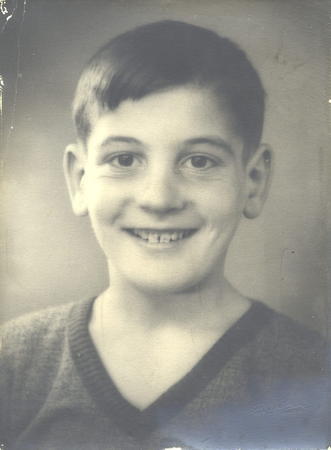
As a thank you, all contributors were sent a large photograph of their child. In a stack of old photos handed in by the blacksmiths and machine workers, just such a portrait turned up. It was Pedro Acebo Arisqueta, the boy that Club 42 at the Army Laboratory had supported. He was 10 years old when he arrived in Denmark, came from the Basque city of Bilbao, and probably had an older sister or cousin, Carmen, among the children in Ordrup.
Christmas 1937 was celebrated with a Christmas tree that the children had helped cut down themselves, presents, Danish songs and Spanish performances, and not forgetting that each child had to write a Christmas card to their “foster parents”!
The goodwill of the donors was sorely needed in the future. For practical reasons, the children had to be divided, and 30 big boys were sent to a colony on Funen. Later, for financial reasons, they were all gathered in a new camp on Funen, and finally the decision was made to send the children back to France again, but now to an international children’s camp with Danish supervision. The children would be closer to their homeland, the food and climate would suit them better, and the costs would be significantly lower.
Many “foster parents” continued to support the children in the French camp, sending cards and telegrams at Christmas 1938, while the Committee made sure there were gifts for everyone.
The Civil War lasted almost three years and claimed immense sacrifices on both sides of the front. On April 1, 1939, the war was over. Almost all Republican resistance had been defeated, Madrid had fallen and Franco, at the head of the rebel army, could declare the war won.
The committee dissolved itself in June 1939, and the children were eventually sent home to a dubious future in Spain. We know a little about Rafael, Jose, Ramon, Anselmo, Antonio, Francisco, Julia, Liborio, Hortensia and Pilar, but unfortunately nothing about Pedro.