 Search
On January 30, 1933, Reich President Hindenburg appointed Hitler Chancellor and brought Hitler fascism to power. Thus began the twelve darkest years in German history. Four weeks later, the German Reichstag was in flames. The fire, still controversial among historians [see below], became the pretext to arrest 1,500 communists, social democrats and opposition intellectuals in Berlin and 10,000 across the country that very night.
By Hans Uwe Petersen
At the scene of the fire, police arrested a young Dutchman, Marinus van der Lubbe, who had been a member of the Dutch Communist Party until 1931. Immediately, the Nazis sought to hold both the German communists and the international communist movement responsible for the fire. The day after the fire, the Reich President’s Decree for the Protection of People and State was issued, suspending the democratic rights of the constitution and paving the way for the legalized persecution of Nazi political opponents.
As the fascist dictatorship was not yet fully established and also partly as a result of pressure from abroad and the activities of German communists outside the country, the Nazis were forced to carry out a process that they would otherwise have preferred to avoid. The police investigations focused on van der Lubbe, but at the same time the German communist Ernst Torgler and three Bulgarian communists, Georgi Dimitrov, Blagoi Popov and Vassil Tanev were also put on trial as the instigators of the fire. The trial lasted from September 21 to December 23, 1933. Hermann Göring and Joseph Goebbels, who appeared as witnesses, were unable to dispel the general impression that this was a political show trial. Just one month after the Reichstag fire, the penalty for arson had been retroactively increased to the death penalty. Van der Lubbe was also sentenced to death, while the Nazis suffered the indignity of having the other four defendants acquitted due to lack of evidence.
Throughout this process, efforts were made outside the borders of Hitler Germany to uncover the Nazi intentions behind the trial.
This was also true in Denmark.
As early as May 3, 1933, the German consulate in Aalborg was painted with anti-fascist slogans. On September 30 and again in October 1933, members of the Danish Red Aid carried out actions in Frederikshavn. First, posters were put up at the German consulate with the slogan “Down with the arsonists Hitler, Göring and Goebbel” and a call to support the victims of fascism. A few days later, a poster was put up at the town’s coal yard, run by the German consul, calling for solidarity with the German workers and urging them to boycott the consul’s fuel store. The actions led to a protest from the German embassy in Copenhagen and a complaint against the consul in Frederikshavn. Despite the police investigation of the case, another action was taken against the consulate. On the night of October 21-22, 1933, the slogan “Down with the arsonist Göring” was painted on the walls of the consulate. The result was even photographed and subsequently printed as a postcard.
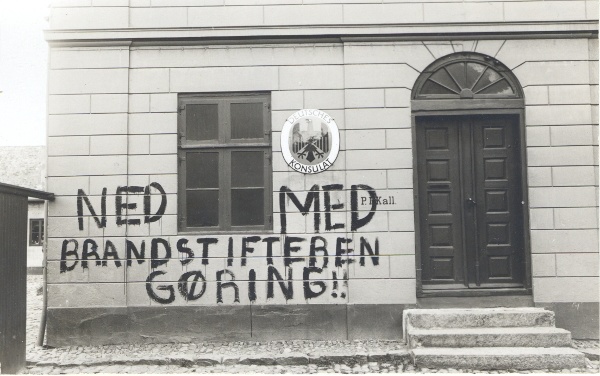
However, on October 24, a reliable informant – as stated in the police material – managed to arrest three German communists who, according to the authorities, had participated in the actions against the consulate in Frederikshavn. They were brought to Copenhagen and released a few days later when Red Aid recognized them as refugees. However, under pressure from the authorities, they left Denmark in late February and early 1934 and traveled to the Soviet Union. In the meantime, the police had banned the sale of the postcard and two members of the Danish Communist Party were – despite their denial – fined DKK 400 or 30 days in prison for painting at the German consulate.
However, this did not put an end to actions against Hitler’s Germany. In December, the German consulate in Aarhus was also painted over and similar actions were carried out in Esbjerg and Kolding.
The controversy over the Reichstag fire
While the Nazis initially sought to hold international communism in general and the German Communist Party in particular responsible for the Reichstag fire, the communists were quick to claim that it was the Nazis themselves who had set fire to the Reichstag. The Nazis saw van der Lubbe as a tool of the Communists, while the so-called “Brown Books” and Communist agitation emphasized that the Dutchman was not a Communist, but a confused young man who had been abused by the Nazis because of his homosexual tendencies. In historical research in the post-war years and up to the present day, the fire has been discussed very controversially. This discussion is about whether or not it could be true that van der Lubbe alone could have started the fire. At the same time, the dispute also revolves around an assessment of the importance of the Reichstag fire for the establishment of Hitler fascism in Germany. The debate has not only been lengthy but also filled with accusations of document and source falsification on the one hand and a careless handling of new source material that has become available after German reunification.


