 Search
Two DKP posters from the 1930s, found in the ABA’s poster collection, contain a curious little story.
By Hans Uwe Petersen
In connection with the general election on November 16, 1932, the Danish Communist Party (DKP) published two posters with identical images but with two slightly different texts. The slogan on one poster read: “Should this system continue? No! Against class justice. Vote communist”. The other poster read: “Social welfare. Against class justice. Vote communist”. With 17,179 votes (1.1% of the votes cast), the election gave DKP 2 seats in the Danish Parliament for the first time.
The posters portray the police as baton-wielding enforcers of justice. The poster makers may have thought that exaggeration promotes understanding. In any case, the depiction of the 3 officers on the bottom right of the poster is a photomontage. As can be seen from the original image, the officer in the middle had lost his helmet. The third police officer on the poster has been moved closer to the other two and at the same time he has been provided with a police baton. It is not known whether the poster’s other image elements are also a photomontage.

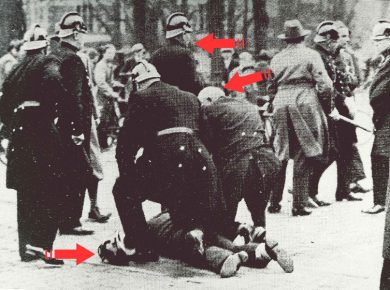
The original image originates from a clash between protesters and police in connection with the Supreme Court’s consideration of the verdicts in the Nakskov case on October 8, 1931. The man overpowered by the two police officers is a member of DKP, Charles Junge, who had previously beaten up police officer Johan Heiberg. Both Charles Junge and two others were arrested and later convicted in the High Court on January 13, 1932.
The demonstration, which continued the following day, was largely a result of the work of the DKP and the ‘Nakskov Committee’ established by International Red Aid in mid-August. The committee had held a large meeting at Borups Højskole on September 8, 1931, with Poul Henningsen and others as speakers. Only 8 days before the clash between the police and the demonstrators, the committee’s pamphlet “The Nakskov Case” had been published.
The Nakskov case was an offshoot of the social and economic crisis of the early 1930s. The world crisis that had erupted in the US in 1929 reached Denmark in earnest in 1931. At the beginning of 1932, half of all workers were unemployed and for the year as a whole the unemployment rate reached 32%. The rapidly growing unemployment in 1931 had serious social consequences. Benefits were so low that an unemployed person had to support their family on a third of a normal daily wage and after 115 days they were no longer eligible for benefits. The problems were exacerbated by the fact that a significant number were not members of an unemployment fund. As a result, around half of the unemployed had to rely on relief funds, which had very limited resources at their disposal. Particularly affected were young people and young unskilled workers who never managed to become eligible members of an unemployment fund. Many of these young people also became homeless, partly because they could not pay rent and partly due to the general housing shortage.
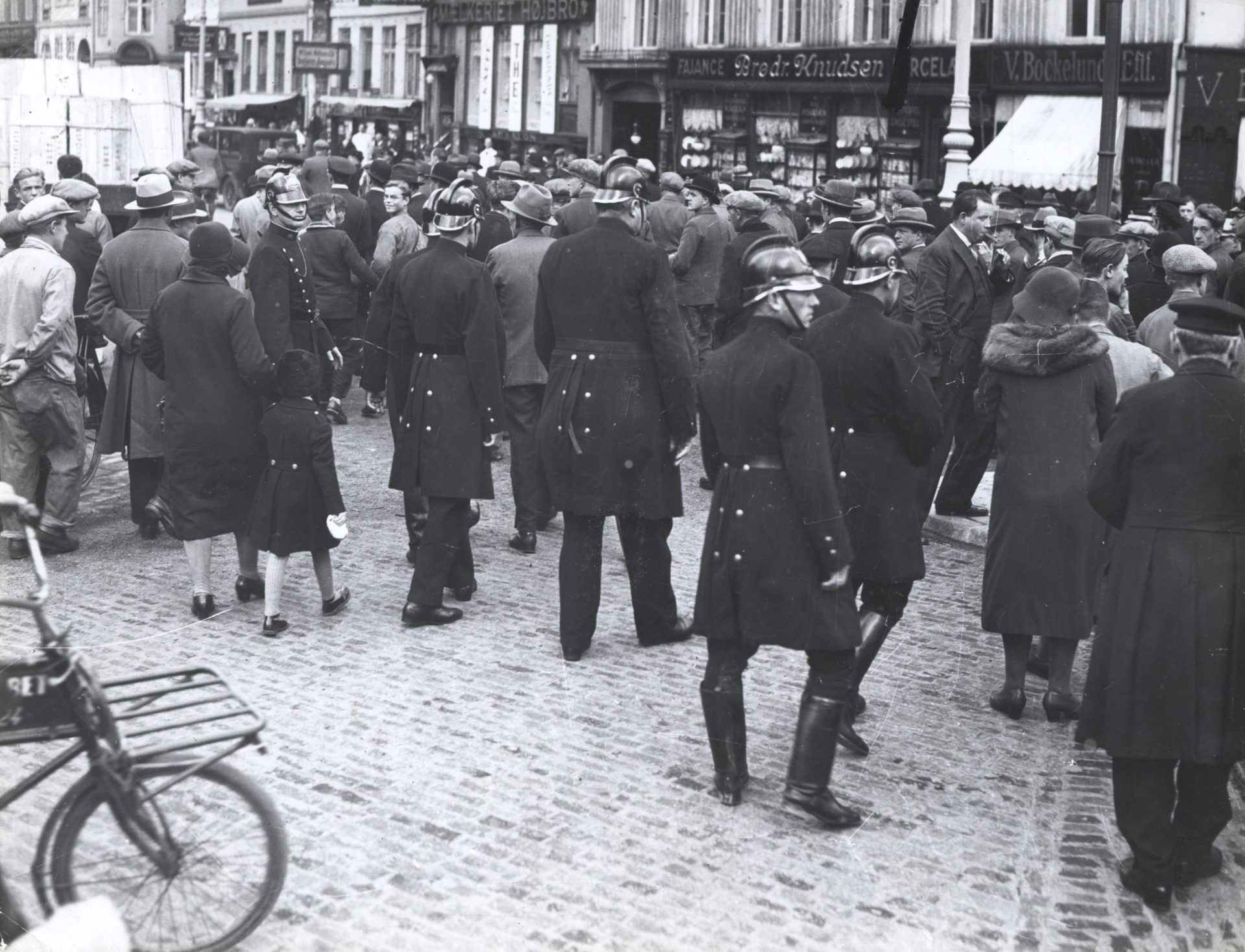
Download the pamphlet Nakskov case 1931
In this situation – with the active participation of DKP – ‘De Arbejdsløses Organisation’ (DAO) was formed, which had local branches in many parts of the country. In Nakskov, DAO was established in December 1930 and in early 1931 the town also got a DKP branch. At a town council meeting on February 2, 1931, the local DAO branch attended and read a resolution with the organization’s demands for more help. Initially, the demands were met after the city council allegedly felt threatened into saying yes. But the very next day, the city council withdrew the grant and the police arrested two DKP members who were believed to be behind the action.
Leading up to May 1st, the fronts were drawn further apart. The Social Democrats canceled their May Day rally and the police banned DKP from holding their demonstrations. This didn’t stop the party from defying the ban and there was a confrontation between the demonstrators and the police. The police’s actions caused a lot of anger and in connection with a public protest meeting on May 2 in the municipal Inner Fjord facility, there were new clashes between the police and the demonstrators. As the procession passed the police station, the situation escalated and stones were thrown by the protesters. The chief of police in Nakskov then called for reinforcements from both other police stations and the military. The following day, a large number of arrests were made. In the legal aftermath, 9 so-called main men were sentenced to between 4 months and 2½ years in prison. The events led to the aforementioned clashes between police and protesters in October 1931, which found their way to the DKP election poster.
Others also read

THE STAUNING OF ALL OF DENMARK
Thorvald Stauning was a beacon in Danish politics and is the longest-serving prime minister of the 20th century

WITH THE LAW OR WITHOUT
In 1871, the living conditions for the few industrial workers in Denmark at the time were appalling. But when the labor..

THE BATTLE FOR TIME
Working 48 hours a week. It sounds like a lot for a Danish worker in 2019. But 100 years earlier, it was just..


