Search
On June 4, 1872, the International Workers’ Association called for the first time for a constitutional celebration on June 5, 1872, at 14:00. The meeting was to take place outside the jurisdiction of the Copenhagen Police.
By Jan Ingemann Sørensen | 11.05.2009

Crone’s ban on the red flag
Crone’s assembly ban of May 4, 1872 did not allow meetings to be held in the open air in Copenhagen. Dyrehaven was under the jurisdiction of Nordre Birk. Therefore, the meeting was called to be held at Den slesvigske Sten in Dyrehaven, and for this occasion, the International Workers’ Association had decided for the first time to use the red flag with the inscription “Freedom, Equality and Brotherhood”.
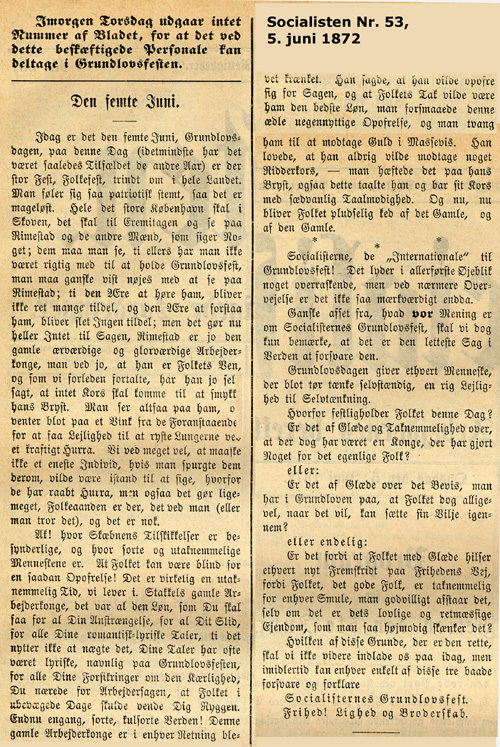
The argument for the socialists to start celebrating Constitution Day was presented in Socialisten, comparing the situation with Ørsted’s government in 1853-54, where the protest against the government at that time gave rise to the first constitutional celebrations. And on the day itself, they argued more directly in today’s editorial in Socialisten. “Constitution Day gives every person who dares to think independently a rich opportunity for self-thinking”.

On the same day that the notice of meeting appeared in Socialisten, the International Workers’ Union’s new board and the party committee were summoned to a meeting with Police Commissioner Crone. He wanted to inform them of the precautions he had taken in connection with the International Labor Union’s celebration of Constitution Day and handed out a written ban on the use of the red flag, both at the Constitution Day celebration and anywhere else in Copenhagen, because it was his opinion that the red flag had a “threatening meaning”.
Crone’s ban on the red flag was published in Socialisten on Constitution Day itself and Würtz commented on the ban by expressing uncertainty as to whether Crone could issue such a ban at all; but Würtz recommended that “in each case it must be obvious to everyone that we must hold the festival without a flag.”
The socialists’ first constitutional party
By 2 pm, there were hardly 100 people at Klampenborg Holdeplads, with the red card on their chest or the red bow in their buttonhole that would characterize the participants at the first socialist constitutional party. The chairman himself arrived half an hour late, so the march to Den slesvigske Sten was somewhat delayed. The police, on the other hand, showed up on time and it even seemed that the police knew a significant number of the attendees, as several of them kindly and understandingly answered all police inquiries.
As the number of attendees began to grow, people flocked around the music and when about 500 participants, in addition to ladies and children, had gathered, a procession led by the music and singing “The Socialist March” made its way through the Hermitage Forest towards the Schleswig Stone.
When the procession had arrived at the festival site at the Schleswig Stone, a stop was made to prepare for what was about to happen. After fifteen minutes and the top of the Schleswig Stone had been covered with a red cloth, mason Jeppesen opened the series of speeches with an urgent appeal to the assembly to show calm and order, otherwise the board would be held responsible for any disorder. The chairman, cigarmaker Würtz, could then begin his speech.
Workers’ first constitutional speech
Würtz began his speech by rejoicing that he was now able to fulfill the promise he had made in the association’s premises that on Constitution Day he would deliver a toast on the Schleswig Stone for the working class. And in order for that to be possible, he had had to proceed calmly and deliberately, which he hoped every right-minded and reasonable man would agree with. Würtz continued to question whether workers should participate in the constitutional celebrations at all, but he was convinced that they should, because there was a clause in the Constitution that grants workers a certain freedom. But hardly is this freedom granted to the worker until there are other similar clauses that deprive the workers of this freedom again. But in other respects it may be necessary to celebrate this day, because the workers should remember the initiative that was taken in trying to put the inherited unrestricted power in the hands of the people. Yes, we can learn from the Danish people’s behavior in 1848: When we stand together in solidarity, any wish can be realized, Würtz emphasized.
Würtz then mentioned the following points as a program he would always fight for: Free and common education for all, more education will reduce crime and fight the distance between capitalists and workers.
Finally, Würtz noted that although socialists regard the whole world as their homeland, it is deeply imprinted in the human heart that one has a certain fondness for the place where one was born, and wherever one goes, one sometimes dwells in thought on the spot where one saw the light, however, when so many cheers for king and country were shouted around the country, he wanted to give a cheer for the working class here under the open sky, the first that was possibly given on this day, but which he hoped would not be the last. This speech was answered by a ninefold cheer from the assembly. After Würtz’s speech, several other people spoke and between the speeches the Socialist March was played. After the speeches, the serious part of the party was over and for the next few hours the members ate the contents of the food baskets they had brought and had a little swing.
The end of the Constitution Day celebrations
When the party was over, the association marched through Dyrehaven along Jagtvejen to Charlottenlund where the chairman thanked the association for the dignified way in which it had performed and finally Würtz asked everyone to preserve the memory of this beautiful day and expressed the wish that it would not be the last time they gathered in this way. The first socialist constitutional meeting was over and the event was a success. Although the newly purchased red flag was not allowed to flutter in the wind on this occasion, the socialists put their “red” symbolism on the day by meeting at the red gate, wearing red membership cards and red bows and, not least, covering the top of Den slesvigske Sten with a red cloth. The socialists demonstrated that it was not only a bourgeois endeavor to commemorate the Constitution as a national symbol.
The International Department’s internal aftermath about the red flag
The Socialists’ first constitutional celebration was thus held in peace and order – without the red flag. Würtz had to account for this leniency towards police chief Crone on Saturday, June 8, 1872. The new line did not seem to harmonize with the decision and the discussion that had taken place in the association. According to Socialisten, Giesing and Forsberg had directed “unfounded personalities against Würtz” that evening, but Würtz got off scot-free and was supported in his proposal to take legal action against the chief of police and draw up a written complaint to the Minister of Justice.
The first socialist constitutional convention and history?
The Socialists’ first constitutional convention was not a lost cause, as party history tries to give the impression. On the contrary, as the contemporary press wrote, it was a political celebration, with between 500 and 700 people taking part in almost six hours of festivities, including speeches, music and dancing. And even though the red flag was not included in the socialists’ first constitutional meeting in Dyrehaven in 1872, the decision that the flag should have been included is of historical significance for the labor movement, because Police Commissioner Crone’s ban on the red flag created a fundamental discussion and an independent Danish position on the meaning of the red flag.
See also Carl Würtz’s letters to Angelo Haase.