Search
Villy Fuglsang died in September 2005 after a very long life in the service of communism. He is especially remembered for his participation in the Spanish Civil War and for his internment in the Horserød camp and in the German concentration camp Stutthof during WW2. World War II.
By: Jesper Jørgensen
Spain and Stutthof
Villys Fuglsang’s life began on April 17, 1909 at Radstrupgaard between Odense and Kerteminde, where his father worked as a foreman. Growing up, the family moved around a lot between manor houses on Funen and in Jutland. After secondary school, Villy chose to follow in his father’s footsteps. He first became a forage apprentice, then a forage master. He also took over his father’s interest in politics, reading the communist Workers’ Magazine and his interest in the conditions of farm workers and developments in the Soviet Union. In 1928, Villy went one step further and joined the Danish Communist Youth (DKU).
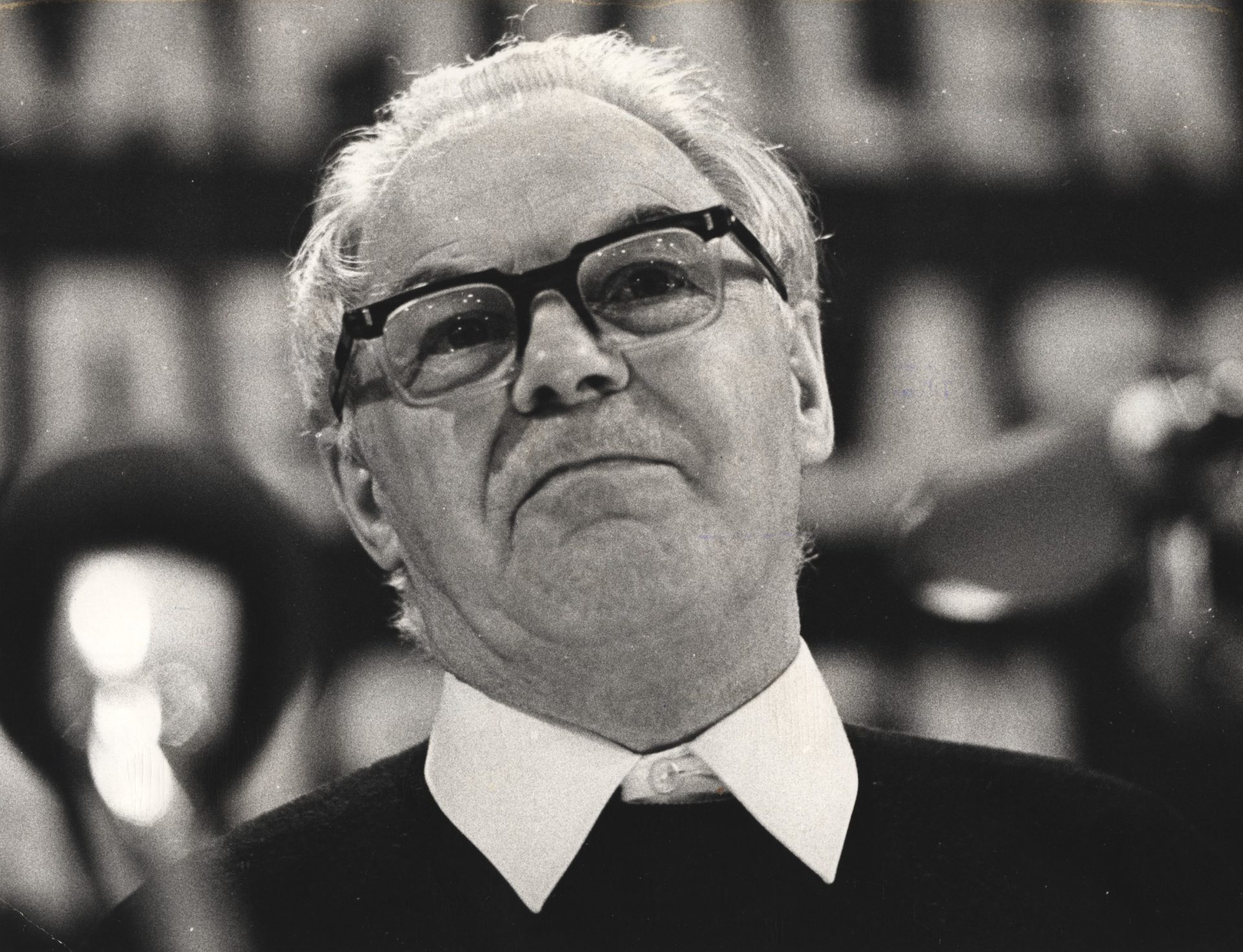
In 1934, Villy Fuglsang was elected to the DKU’s main board, and the following year he was selected (together with the later DKU chairman, Alvilda Larsen) to participate in an 18-month party course at the International Lenin School in Moscow. However, Villy did not manage to complete the entire course, because in the fall of 1936 he volunteered to fight against the fascist uprising in Spain. During his stay in Spain in 1937-38, Villy was appointed political commissar in the International Brigades’ Martin Andersen-Nexø Company, where most Danish volunteers were based.
Back in Denmark, Villy Fuglsang was sent to Aalborg, where he soon found his Elna. They were married in October 1940, but only 8 months later, on June 22, 1941, they were involuntarily separated. The reason was the German occupying forces’ demand for the internment of leading Danish communists because Germany had gone to war with the Soviet Union that day. Villy was arrested and ended up in the Horserød camp near Elsinore. After the Danish government withdrew in August 1943, The Bird, a nickname Villy was given by his comrades in Horserød, and 149 others who failed to escape from the camp were transferred to the Stutthof concentration camp near Danzig (Gdansk). Life in Stutthof was, in Villy’s own words, “like in another world” and would affect him for the rest of his life. One of the hardest trials was the separation from Elna, which you can get a sense of in the many letters the two young people exchanged with each other during the internment period and which are now part of the archive.
Party soldier
In the post-war period, Villy Fuglsang gained a central position in DKP. In the elections in the fall of 1945, he was elected to the Danish Parliament, where he served a total of three terms: 1945-1947, 1950-1960 and 1973-1978. In the party, Villy was an elected member of the Central Committee from 1939 to 1990, and he also served as secretary, member of the executive committee and chairman of the North Jutland district. After the fall of the Berlin Wall, Villy followed the hard core into the Communist Party of Denmark (KPiD), where he was in the national leadership until his death. During his long political career, he was particularly involved in the agricultural sector, but he was also interested in internal party training and the history of the labor movement. In his later years, the historical perspective came more into focus. His time as a volunteer in the Spanish Civil War and his stay in Stuttgart became the focal points of his many oral and written contributions to the public debate. He was a sober, modest and hard-working party soldier of the old school from the 1930s who believed in the Soviet Union and communism to the end.
The archive
After Villy Fuglsang’s death, the Workers’ Museum & ABA contacted his daughter, Gerd Fuglsang, who initially didn’t think there was much left behind. Elna was said to have continuously “cleaned up” the papers to make room in their small two-room apartment in Aalborg. Fortunately, something was preserved. The correspondence between Elna and Villy during the war is unique. The approximately 370 letters were written under censorship and therefore do not contain political material, but the correspondence is heartbreakingly poignant as a human fate story. In short, it is a love story. The archive also contains a good collection of Villy’s personal records, not least about the death march that the Stutthoff prisoners were sent on when the Russians advanced from the east in the last months of the war. The archive, which consists of 18 archive boxes, also contains Villy’s pocketbooks with scattered notes from 1940 onwards, letters from the family, manuscripts etc. from the period 1937-2005.
Villy Fuglsang Archive
Year: 1937-2005
Scope: 18 boxes
- Newspaper clippings 1950-2005
- Danish Communist Party 1945-1998
- Elna Fuglsang 1937-2005
- Cases arranged by subject 1937-2005
- The Danish Parliament 1937-1989
- Correspondence 1940-2005
- Pocketbooks and other records 1940-2003
- Manuscripts 1940-2000
- Passports, membership books and similar 1931-1990
Literature
Villy Fuglsang: As I remember it. Aalborghus, 1985
Ole Sohn: Der var bud efter dem. Four tales of fate from the revolutionary milieu of the 30s. Vindrose, 1994
Others also read

THE STAUNING OF ALL OF DENMARK
Thorvald Stauning was a beacon in Danish politics and is the longest-serving prime minister in the 20th century

WITH THE LAW OR WITHOUT
In 1871, the living conditions for the few industrial workers in Denmark at the time were appalling. But when the labor..

THE BATTLE FOR TIME
Working 48 hours a week. It sounds like a lot for a Danish worker in 2019. But 100 years earlier, it was just..