Search
By Hans Uwe Petersen
The Students’ Vietnam Action (DSVA) grew out of the so-called Moratorium Days on American campuses in 1969. The ‘Moratorium to End the War in Vietnam’ was a nationwide demonstration in the US on October 15, 1969. The moratorium called for a general strike if the war had not been ended by October. The Moratorium Days were a significant success, gaining a very large following not only in the US but around the world. In Boston, around 100,000 people took part in a demonstration and Bill Clinton, then studying at Oxford, helped organize demonstrations in England. On November 15, the next big demonstration followed, bringing together more than 500,000 participants in Washington.

DSVA, which included people like Lars Hutters, Morten Thing, Jens Guldager, Hatla Thelle, John Gilliam, Ke Møller Kristensen and Nina Møller Kristensen, set out to mobilize university students against the Vietnam War. However, these people were also active in other parts of the Vietnam movement, including the ‘Action Committee of May 7, 1969’, which also took to the streets to demonstrate against John Wayne’s film ‘The Green Berets’, which expressed support for the US war in Vietnam.
Among other things, DSVA took the initiative to collect teaching materials for Hanoi University. The group also organized hearings and debate meetings at the universities in Copenhagen and Aarhus. In parallel with the activities in the US, 1,500 students boycotted classes in Aarhus on October 15, 1969 to participate in a major debate event instead.
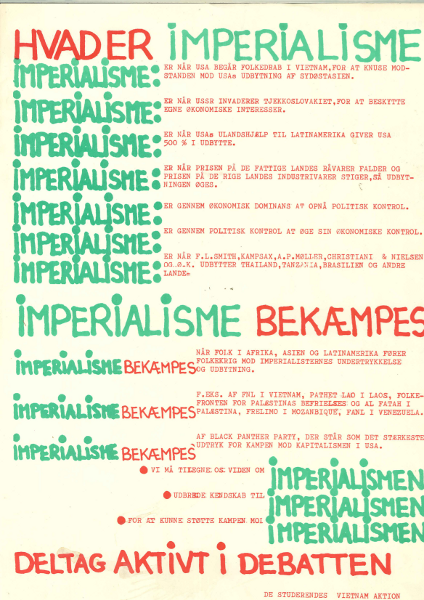
The poster, created by Nina Møller Kristensen, is a testimony to how a general critique of society was sought to be included in the solidarity work. The distinctive feature of this poster is that it is designed as a piece of educational material. The text not only criticized the Western countries, but also condemned the Soviet Union’s aggression against Czechoslovakia in 1968. The poster was published in autumn 1969. In the discussions about the development of the solidarity movement, DSVA belonged to the wing that – led by the Danish Vietnam Committees – advocated unconditional support for the freedom movement in Vietnam and considered purely humanitarian aid work to be insufficient.