Search
The syndicalists, the left wing of the trade union movement, are tired of negotiations. They demand direct action. In 1918, the bricklayers decide to go home at noon on Saturdays. After several strikes, the 8-hour day is gradually introduced. Employers attempt to abolish the 8-hour day again. Social assistance is established.

Syndicalists and the weekend movement
One of the effective experiments that the syndicalists help inspire is the “weekend story.” It emerged at the end of May 1918 and was officially confirmed when, on June 13, 1918, the bricklayers’ union passed a resolution that journeymen should stop work at 12 noon on Saturday. In the following months, bricklayers, carpenters, stonemasons, construction workers, earthworkers and concrete workers also agree to join the weekend movement.
The Weekend Movement ends in the autumn of 1918, after the protesting workers and their organizations are heavily fined by the Permanent Court of Arbitration. A work stoppage is repeated in 1919 when the Copenhagen construction workers demand an eight-hour workday – they simply go home after eight hours. Stauning is not happy about the situation. Interior Minister Ove Rode writes in his diary: “He seemed somewhat anxious about tomorrow’s syndicalist demonstration and attempted strike.
“The eight-hour day, on the other hand, reaches into the established negotiation channels. Other syndicalist-supported actions include a work stoppage among around 643 Copenhagen bakery workers in August 1918, the Copenhagen dockers’ strikes in May and August and the somewhat smaller conflict at the Copenhagen floating dock in May 1919.
the 8-hour day is introduced
At the end of January 1919, the main organizations agree to make a gradual reduction in working hours. A daily working time of 10 hours, for example, would be reduced to nine hours. But the unions want to go even further. The two parties agree to each appoint five members to a committee to investigate the possibilities of an eight-hour working day. But suddenly things start to move fast. When the construction workers learn that it will take five months for the committee to meet.
Copenhagen bricklayers, carpenters and bricklayers who are not members of the Confederation of Unions begin a strike. The construction workers’ strike is particularly painful. The housing shortage in Copenhagen is great, and an action by the construction workers is extremely powerful. As a result, the cooperating unions want the committee on the eight-hour working day to begin its work immediately. This is stated at the general meeting in April 1919.17
On May 1919, the two parties agree on the collective agreement, which includes the eight-hour day rule. The reduction in working hours must then be implemented as soon as possible in the trades where the employers and workers agree, and in all trades they must be implemented by January 1, 1920. However, some occupational groups are exempt from the collective agreement. This applies to workers in shipping and agriculture, and related trades. As well as drivers, boilermakers and others who work under special working conditions
Read more about the fight for the 8-hour workday here.
The Great Lockout of 1922
During collective bargaining in 1922, employers concentrate their efforts on continuing wage reductions and mitigating the economic impact of the eight-hour day on business. The employers do not attack the eight-hour day directly, instead, during the negotiations they try to agree on certain “necessary adjustments” to the working time regulations in addition to a wage reduction of between 15 and 25 percent, as stated in the DsF report. The negotiations break down. The employers’ resistance is particularly strong. Soon after, extensive lockout notices and a mediation proposal from the conciliation body follow, which is rejected by both workers and employers.
In the third week of the lockout, the Reichstag decides that unemployed people who have been unemployed for 60 days before the lockout begins are entitled to unemployment benefits. This strengthens the unions’ conflict strategy. The conflict continues, but when Minister of the Interior Kragh, through a circular dated March 21, closes unemployment benefits in the affected trades, concern grows among the unions. On April 4, the main organizations agree to a proposal prepared by the conciliator. The agreement entails a 15 percent reduction in wages – with 12 percent for the lowest paid – and the eight-hour day is retained.
Only the labor union refuses to agree to the settlement. The employers don’t care; they agree to reduce wages by 15% anyway. When the dockworkers in Copenhagen, among others, went to work anyway, the Danish Workers’ Union decided to sign the collective agreement with DA. This ended the conflict in all unions – including the “general strike” in Randers.
Community aid
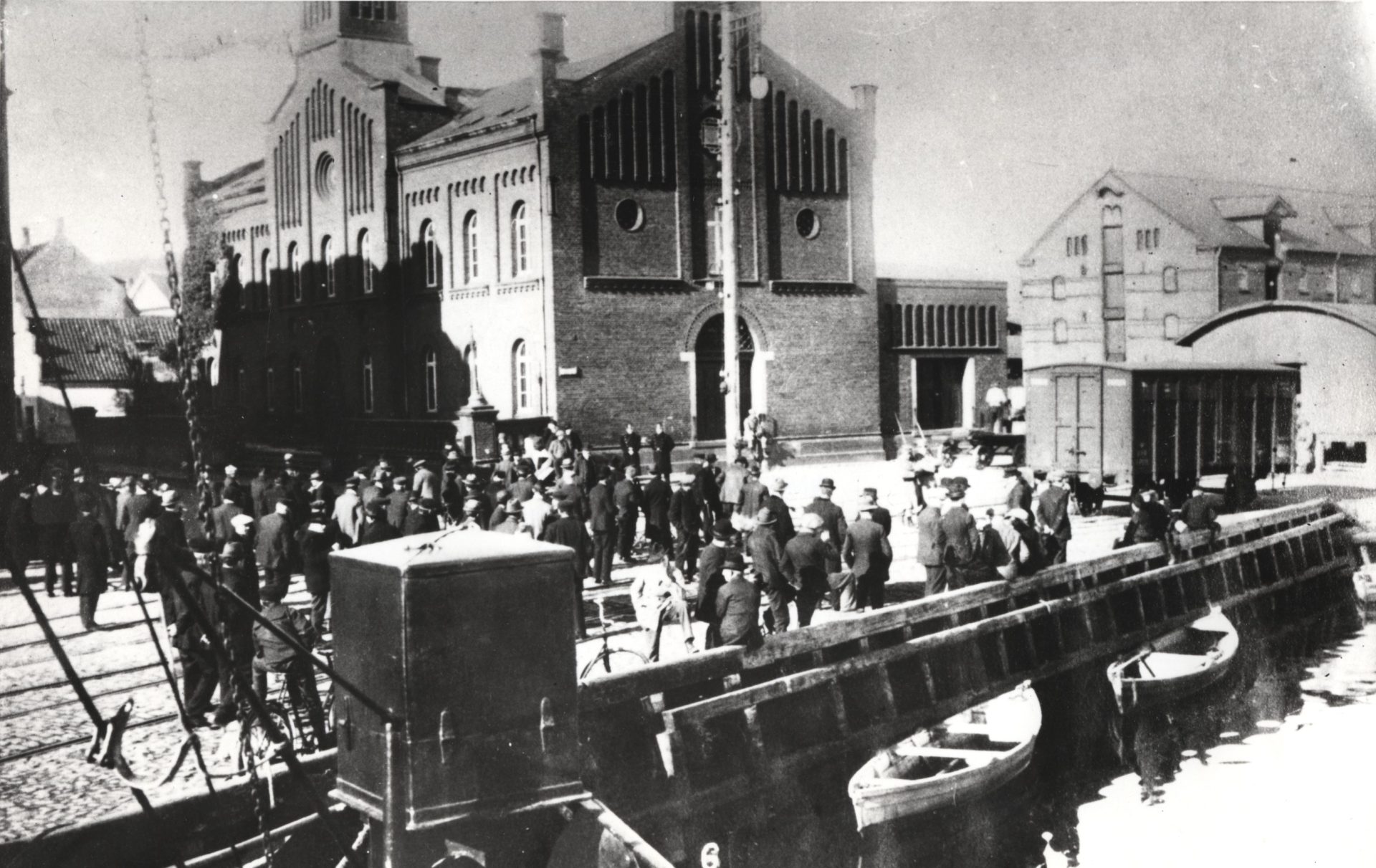
A seed company in Randers uses scabs to unload a ship with seeds. The locked-out workers gather at the harbor, and shortly after, the rage explodes. That evening, the workers hold a meeting and demand that the scabs and police be removed from the harbor. The chief of police won’t hear of it. He throws some of the workers who attended the meeting in jail for 30 days and declares Randers in a state of emergency. And as a result, the general strike is a reality. The police chief calls in the dragoons and a team of scabs from Samfundshjælpen to keep the municipal works running.
Samfundshjælpen is an organization of scabs created by employers and right-wingers in 1920. They were to step in when strikes paralyzed important social functions, giving the strikebreakers a sense of moral justification. In Randers, the strikebreakers are protected by the police and military. The strikers receive no help. The cooperating trade unions close the strike box. Chairman C.F. Madsen believes that it is all the work of the communists and syndicalists, and they will not support this.
The nationwide conflict ends with a settlement on April 10. The unions accept that wages will be reduced, but the eight-hour day will not be touched. Only a week later, the workers in Randers give up and go back to work. In the long run, it is the strikebreakers from Samfundshjælpen who lose out. Unable to find work, they try to beg for something from Samfundshjælpens supporters. A strikebreaker writes to Ritmester Secher in Randers: “The thing is that by working in Randers, I have been blacklisted by all the unions. Here in Varde I am thus excluded from all work, and any master who would try to hire me is blocked.”