Search
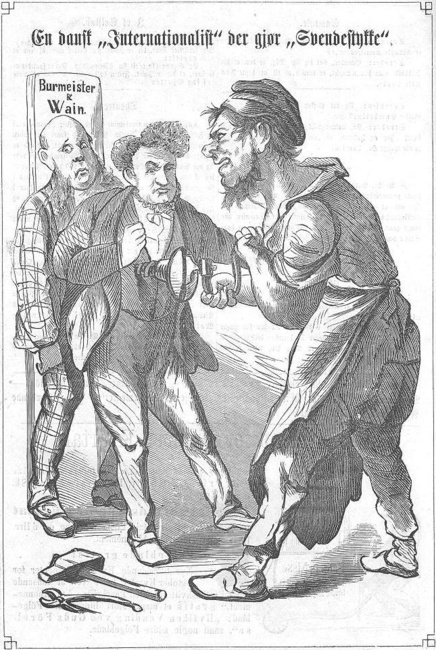
The people took power in Paris in 1871. The so-called Paris Commune ruled the city for 72 days from March to May. The Danish joke magazine Folkets Nisse was quick to make fun of the new movement.
By Erik Voss
Or new and new: The Communist Party’s manifesto had been published almost 25 years earlier and in Denmark, Frederik Dreier had published books with a socialist content in the early 1850s. But the strongly conservative magazine saw the danger signs and published – not very funny – diatribes against the movement.
When Louis Pio published the so-called “Socialistiske Blade” in the summer of 1872, the magazine was on the spot with its first anti-socialist cartoon. However, it wasn’t very good. “Socialistisk Blade” was the starting point for the weekly newspaper “Socialisten”, which began publishing in July 1871.
“The First International had been founded in 1864 in London. The “Socialisten” was the Danish workers’ mouthpiece for the creation of a Danish counterpart: the International Workers’ Association – commonly known as the International. The official founding date was October 15, 1871, which is considered the birthday of the Social Democrats.


Louis Pio was the movement’s chairman, Poul Geleff its agitator and Harald Brix its magazine publisher.
Lars Bjørnbak had founded Århus Amtstidende and was both a pacifist and a member of the International. A highly controversial figure. The lay preacher Mogens Sommer was also a member of the International until he broke with the organization in early 1872. Below, together with Pio and Geleff, they are presented as “The Four Graces”. That’s not very funny in this day and age. The question is, did the drawing have an effect on the readers on 16-12-1871?
For Folkets Nisse, socialism was an “enemy” and the magazine used traditional enemy images. For example, socialism was seen as an anomaly, a disease:
Folkets Nisse had a recurring character: Sørensen, the somewhat simple-minded Dane who comments on many everyday events. He wonders about the price rises – brought about by socialism – and is scolded by his sensible wife, who believes that he himself has been blinded by the same socialists:
During the Paris Commune, the phenomenon – or at least the word – petroleuse emerged. It was a female arsonist. According to the People’s Elf, the members and leaders of the International would also use kerosene.


In the history of the labor movement, the Battle of Fælleden has a unique significance. It took place on May 5, 1872. The day before, Pio, Brix and Geleff had been arrested for encouraging workers to demonstrate on Fælleden against the bricklayers’ slave labor. This is what the bricklayers called the extra hour of work they had compared to other workers.
Naturally, Folkets Nisse was quick to exploit this situation in a “Song about the Revolution on Nørrefælled”. About the arrest of the leaders it states:
“And all the people were so happy
– Because it was Sunday morning! –
And the prospect of “Ballade”
That especially enticed them”
There is also a little joke: “For the Socialist performance at Nørrefælled on Sunday, dragoons were ordered from Næstved; wasn’t this dragonic means a bit draconian?” It is probably the pun itself – and not the content – that has amused both writer and reader.
To top it all off, the magazine also has a drawing that plays on Pio’s call prior to the demonstration: For millennia, the lower class has put up with the degradation of the upper class, so “The measure is full – let there not be a drop more – and it overflows.” Of course, in The People’s Elf, it turns into the toilet bucket is about to overflow.
Perhaps modern advertisers have seen the following drawing of the farmer’s wife imagining the knitting workers. To understand the joke, you need to know that the English word “strike” was pronounced as it was written.
The People’s Santa continued to attack the socialists in the following years. However, we will end this little trip through the magazine with its greeting to Pio and Geleff, as they had been bribed to flee to the USA in 1872.