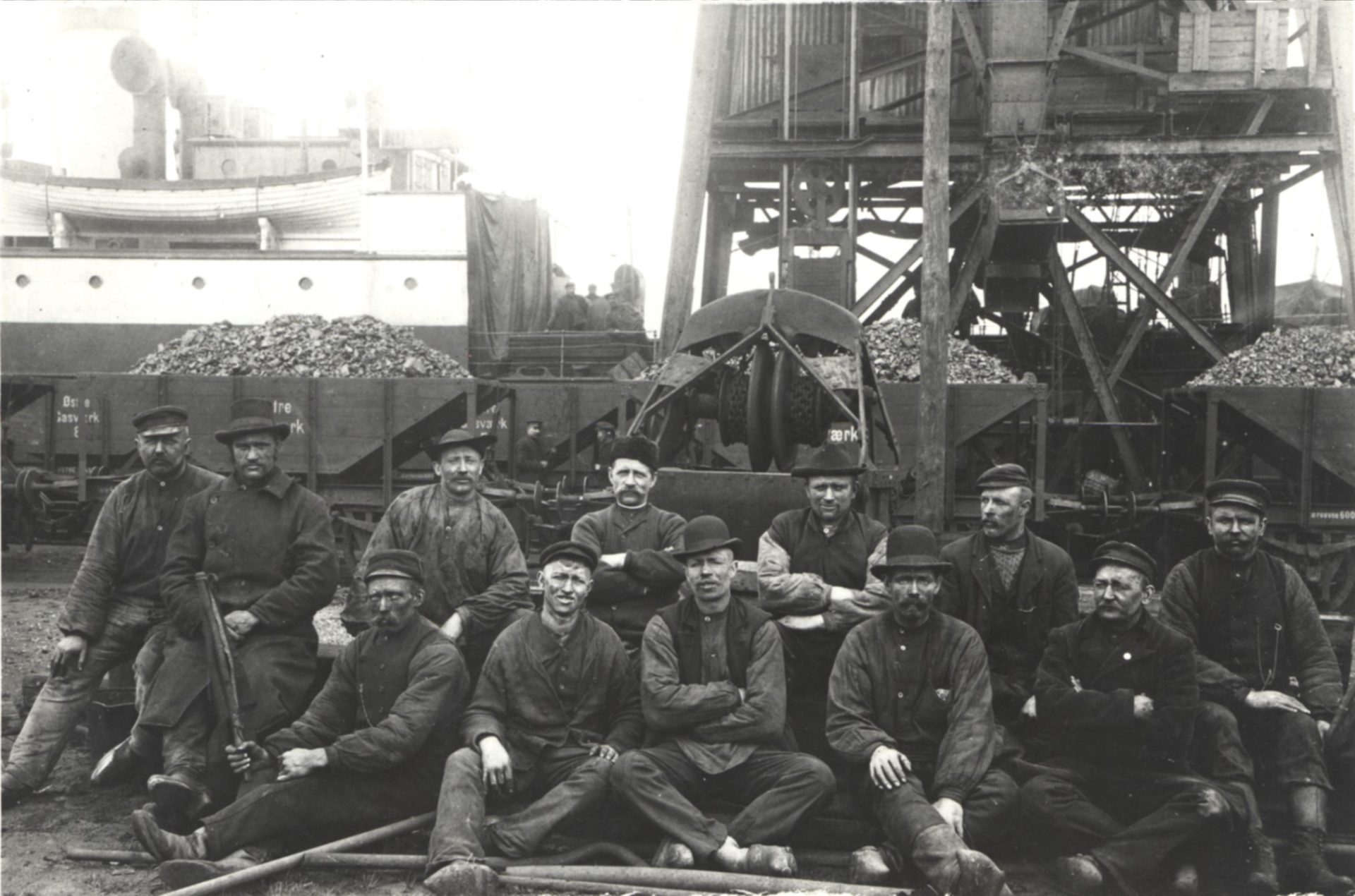
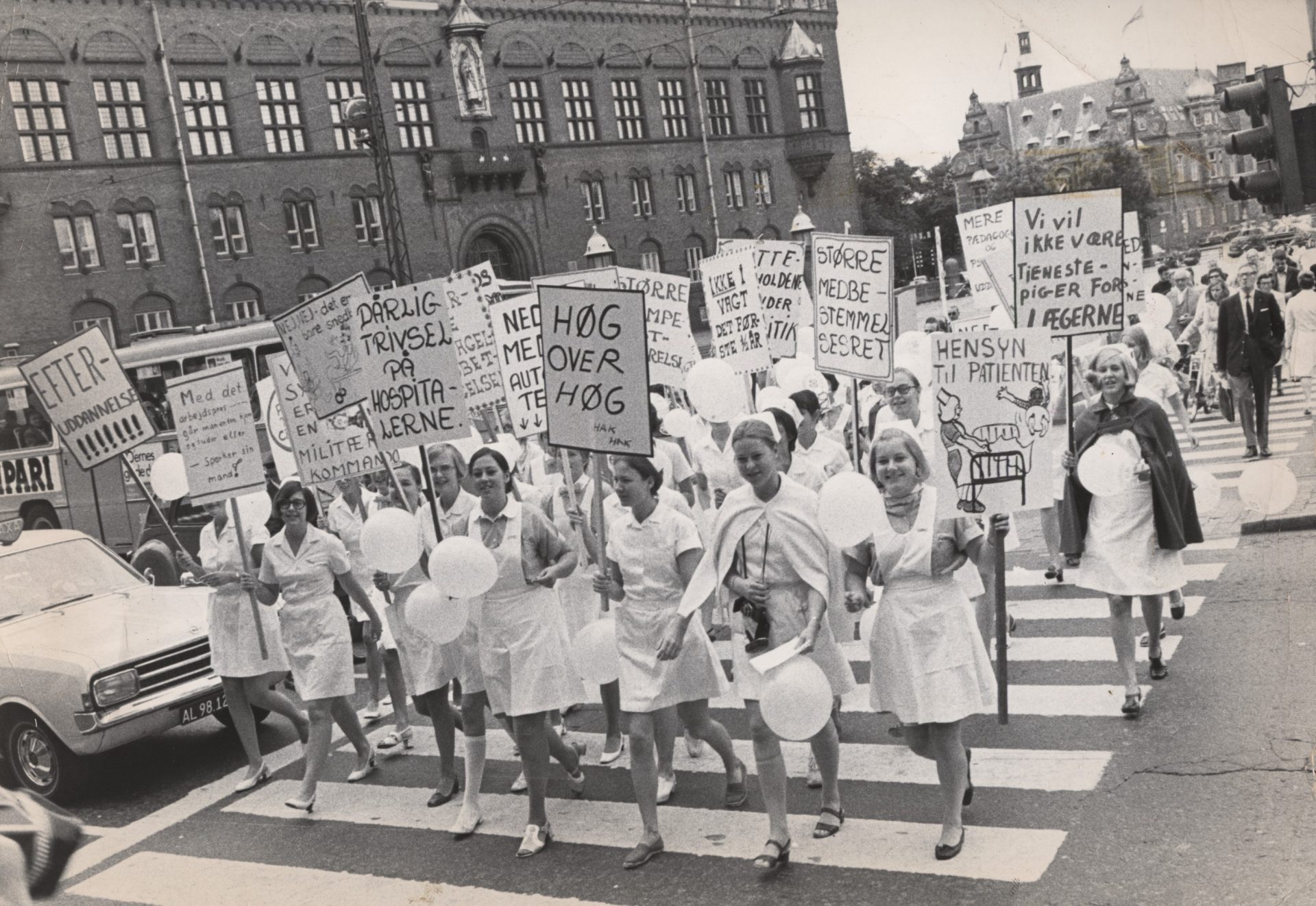
An introduction to LO and FTF’s shared history and conflicts
On Friday 13 April 2018, LO and FTF decided to merge into a single main organization with effect from 1 January 2019. A merger that was previously almost unthinkable. In this theme, we describe the history that preceded the idea of a merger.
On the subpages in the submenu, you can read about the creation of the two main organizations in 1898 and 1952, respectively, and about their conflicted relations over the last 70 years or so.
The prehistory
In the 1870s, the spectre of socialism had arrived in Denmark from abroad. Denmark was still an agricultural society, but Danish workers were growing in number as the cities became increasingly industrialized. Workers began to organize themselves in a common understanding that they constituted a working class with interests different from those of employers (or capitalists as the other side was often called). Inspired by the German theorist Karl Marx, among others, they also developed the idea of creating an ideal socialist society where citizens jointly owned the means of production.
LO is established
In the late 1800s, the labor movement organized itself into three branches: a socialist party, worker cooperatives and the trade union movement. The Social Democratic Party would work to create a socialist society, workers’ cooperatives would free workers from the capitalist form of enterprise, and the trade union movement would organize wage workers against employers. To coordinate and strengthen the workers’ struggle for better wages and working conditions, the Confederation of Trade Unions (later renamed LO) was founded in 1898 as the main organization for the many smaller trade unions.
FTF is established
Until 1952, there was no other main organization for employees in Denmark. But changes were on the way. Denmark was no longer just an industrial and agricultural society in 1950. The service society was emerging and out of it grew a new group, known as white-collar workers and civil servants, whose work areas were primarily trade and office work or other technical or clinical assistance outside industry. Work moved from the machine to the desk.
Business development for the period 1901-1970:
1901
1921
1930
1940
1950
1960
1970
Working class
49,8
49,8
50,3
51,0
49,5
47,8
44,8
Salaried employees
11,7
18,8
20,1
22,3
25,3
29,8
39,5
Self-employed etc.
38,5
31,3
29,6
26,7
25,2
22,4
15,7
Source: Jørgen Goul Andersen: Mellemlagene i Danmark, 1979, p. 100, table 3.6. Goul Andersen’s “mellemlag” is translated here as white-collar workers including civil servants.
The new group of white-collar workers and civil servants felt they were neither workers nor capitalists. Nor did they subscribe to all the goals of socialism and did not necessarily see themselves in opposition to employers. Nevertheless, many of them lacked a trade union organization that was politically neutral. Out of this, FTF (originally the Joint Council of Danish Civil Servants’ and Officials’ Organizations) was formed in 1952. FTF described itself as a politically neutral main organization that fought for the wages and working conditions of this new third class.
One united working class?
The road to a possible merger of LO and FTF has been characterized by many points of contention. One of the central conflicts stemmed from the fact that LO and FTF represented very different membership groups that did not have the same ideas about their identity as wage workers.
An LO for all wage earners?
LO wanted to be the organization for all wage workers. The FTF was seen as splitting the labor movement and didn’t recognize the existence of a so-called third estate, which was supposed to lie between the workers and the capitalists. In reality, however, LO struggled to embrace both the traditional working class, consisting mainly of skilled and unskilled workers in productive occupations, and the growing group of white-collar workers. Culturally, politically and economically, there were major differences between these groups of wage workers.
Clothing was one of the clear external markers that separated the workers and white-collar workers at the Stellings paint factory in 1917. Photo: Arbejdermuset & ABA
Within LO, there was also a shift in membership composition after the 1960s, with the white-collar group growing proportionally more in number than the traditional workers.
Graph based on figures in Arbejdernes Historie i Danmark 1800-2000,by Lars K. Christensen, Søren Kolstrup and Anette Eklund Hansen, SFAHs skriftserie nr. 46, 2007, p. 255.
FTF’s notions of a third estate
FTF had a more clearly defined self-understanding as a representative of a third class that was neither workers nor capitalists. Their members had limited ties to the traditional labor movement’s unions or ideology. FTF members did not see themselves as “workers”, but rather as white-collar workers and civil servants, they did not want to be part of an organization that supported Social Democracy as directly as LO.
FTF did not have LO’s focus on the conflict of interests between wage earners and employers. This was also reflected in the FTF’s attempts during the 1950s to change the Salaried Employees Act from a horizontal principle to a vertical principle. This meant that everyone from the youngest man to the manager could be organized under the same union. LO protested strongly against this, believing it would undermine the entire Danish model where employers and employees organized separately.
“The issue of salaried employees is being discussed and speculated about, and unfortunately, there are organizations [FTF, ed.] that are willing to participate in the speculation of splitting and dividing employees, which they see the possibility of by trying to place civil servants and salaried employees in a group that is different from the other employees. We will not recognize such a division in LO.” -Quote from LO chairman Eiler Jensen in May 1960 (Fællesrådet 1960, no. 6 p. 93)
“The question is not an either/or, but a both/and. FTF has positioned itself in the organization market, and this is where FTF intends to stay” – Leader of FTF’s Joint Council (Joint Council 1960, no. 3 p. 35)
The large new occupational groups that emerged in the mid-20th century also increasingly began to organize and make demands for wages and employment conditions. Here, care workers and young people in training are seen protesting in front of Christiansborg in April 1966. Photographer: Jens Glargaard/ Labor Museum & ABA
Public employees from vocation to struggle
Over the years, however, it became more difficult for FTF to maintain the idea that they represented a separate third class. The 1960s breakdown in traditional patterns of authority and a growing public sector contributed to a change in the self-perception of white-collar workers away from the idea of vocation and towards a more wage-worker mentality.
The continued struggles with both LO and the Social Democratic Party also influenced FTF’s strategy, and the organization gradually shifted during the 1960s away from the idea of a separate third estate. Instead, the FTF saw itself as a complement to LO that could organize groups in society beyond LO’s reach.
Boundary disputes
One point of contention between FTF and LO was that the organizations mutually accused each other of “stealing” members from the affiliated unions.
Where are the boundaries?
Between 1952 and 1973, FTF and LO fought fiercely for members. There were a lot of border disputes about where wage workers should be organized. HK in particular, which was a member of LO, had numerous disputes with FTF over members during this period. According to HK, the FTF unions were stealing members from HK, and accusations also flew the other way. Dansk Funktionærforbund (later Serviceforbundet), which was founded as early as 1911, was also part of LO, which also gave rise to a number of border conflicts.
Dansk Funktionærforbund (later Serviceforbundet) was a union for salaried employees under LO. They came into competition with FTF. Here they hold a congress in Aarhus in 1933. Photo by Atelier Riis Knudsen/Arbejdermuseet & ABA.
During the 1960s, however, it became clear to both LO and FTF that the border disputes were not useful for either LO, FTF or the employees as a whole.
“In the long run, we are not served by having a border that resembles the Israeli-Arab border, where you occasionally jump over and fire a few shots. Both parties have realized this.” -Quote from LO chairman Thomas Nielsen 1970 (Fællesrådet 1970, no. 1 p. 9) about the many battles for members between LO and FTF.
Towards “civil peace”
In 1967, a verbal joint call for a so-called “truce” was made, and over the following years, negotiations to end the border disputes intensified. Changes at the top of both LO and FTF contributed to the milder negotiating climate. And despite strong internal resistance, in 1973 (terminated in 2005) LO and FTF succeeded in signing an agreement that set out procedures for resolving current and future border disputes in a joint mediation board.
The agreement divided the organizational area for salaried employees and civil servants into three parts: LO’s area, FTF’s area and an area not covered by collective agreements. At the same time, the unions under LO and FTF undertook not to go on a membership hunt with each other. Peace was achieved: LO and FTF recognized each other’s right to exist.
“I believe that with these decisions, it will be possible to continue the cooperation between two equal employee organizations in this country, FTF and LO (applause)” – LO vice chairman Kai Petersen at the 1972 FTF congress on the civil peace agreement (Fællesrådet 1972, no. 10 p. 254)
Political neutrality?
Another point of contention that has hampered cooperation between FTF and LO over the years is the mutual accusations that the other party had a political bias. LO actively supported the Social Democrats, which FTF refused to do. And LO in turn accused FTF of being bourgeois and not recognizing the conflicting interests in society.
Mutual accusations of political ties
Especially in the 1950s, LO accused FTF of being bourgeois and justified this on the grounds that CDF (Centralforeningen af Danske Funktionærforeninger), which was FTF’s forerunner and subsequently one of the largest trade unions under FTF, was bourgeois-led when it was founded in 1945 and the years that followed and had conducted strong anti-social democratic campaigns directed against HK. The fact that several of the leading members of FTF up until the 1960s also ran for the Liberal Party and the Conservative People’s Party did not lessen the suspicion.
FTF denied all accusations of right-wing sympathies, but it was public knowledge that FTF had close contact with the right-wing parties, just as LO had contact with the Social Democrats.
As the group of white-collar and civil servants grew dramatically during the 1960s, the Social Democratic Party initiated a more appreciative dialog with FTF. At the same time, any bourgeois tendencies that may have existed in FTF slipped into the background.
Kirsten Stallknect, chairman of the Danish Nurses’ Council and vice-chairman of FTF, and Thomas Nielsen, chairman of LO, meet up with Anker Jørgensen in 1973. Source: Nielsen, Harry.
LO and its ties to the Social Democrats
LO, on the other hand, maintained its close relationship with the Social Democratic Party in the 20th century. Their common historical origins in the Social Democratic labor movement provided strong ties. Gradually, the formal link between trade union movement and party diminished. In 2003, LO officially dropped its party support for the Social Democratic Party, which had a decisive impact on a possible merger. However, this did not stop LO from co-sending the Social Democrats’ election manifesto “Fair Solution” in 2011. Whether this point of contention has been resolved must therefore be open to interpretation.
Why the merger?
Since the 1970s, LO and FTF have come closer together. Especially after 2000, the dialog has evolved. In 2005, LO President Hans Jensen proposed an actual merger. However, FTF rejected the overtures, which were only taken up again in 2012.
“Merger is not on our agenda at all”-Bente Sorgenfrey, President of FTF, 2005
The arguments for a merger are certainly there:
Firstly, both organizations are under pressure on membership numbers. A merger would have the advantage of creating a common front against the so-called “yellow unions”, which are currently capturing members from the traditional collective bargaining unions under LO and FTF.
Secondly, both LO and FTF are facing employers who are centralizing to a large extent, which employees can try to resist through a merger.
Thirdly, the traditional professional groups are breaking up. It is difficult to argue for a sharp division between skilled/unskilled, white-collar and academics anymore.
Fourthly, a lack of merger could result in a division of employees into private employees at LO and public employees at FTF. This could weaken the workforce as a whole.
But are these arguments sufficient to merge organizations that historically and ideologically have such different origins and identities?
Over the last few decades, a number of new groups have joined forces to demonstrate for better pay and working conditions. Here, nurses and DJØFs stand together during a demonstration at the 2018 collective bargaining negotiations. Photographer: Margit Vilstrup
 Search