Search
By Jesper Jørgensen
Denmark and South Africa
The Boers came to power in South Africa in 1948 when their party, the National Party, won the election. Some of the Boers had sympathized with Nazism and Nazi Germany’s struggle against Britain, and after the election victory, the National Party made its racial theories the foundation of the country. All non-whites lost most of their democratic rights and the existing racial segregation was systematized and greatly expanded.
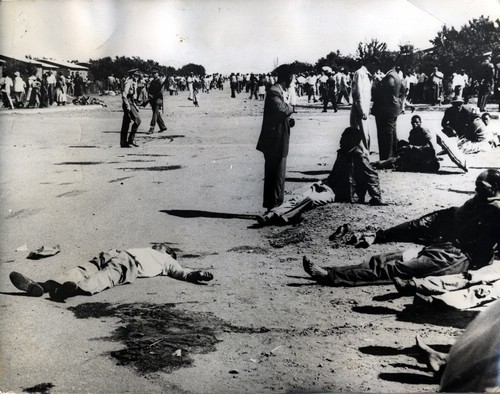
As the apartheid system was built, the resistance of non-white communities grew. A peaceful demonstration that took place in Sharpeville in March 1960 against passport legislation for the black population ended in a massacre. The black organizations – the African National Congress of South Africa (ANC) established in 1912 and the Pan Africanist Congress of Azania (PAC) from 1959 – were soon banned and forced into illegality. In 1962, ANC leader Nelson Mandela was arrested and later sentenced to life imprisonment for treason.
The events of the early 1960s meant that more and more people in the world outside South Africa realized that conditions in South Africa were not as they should be. In Denmark, opposition to the apartheid system manifested itself widely. Most people could agree that a racist regime that openly oppressed a part of its country’s population could not be accepted. Not surprisingly, however, it was the labor movement and the left that were willing to go the furthest in the fight against apartheid.
In 1965, following an appeal from the UN, the Danish parliament passed a resolution to establish a so-called Apartheid Grant for humanitarian development aid and assistance to “the victims of the apartheid policy of the South African government”. The grant was administered by the Apartheid Committee and operated unchanged until 1972, when Foreign Minister K. B. Andersen expanded its size and use to include support for freedom movements in Southern Africa.
In 1976, widespread school strikes broke out in South Africa. First in the Soweto ghetto outside Johannesburg and then across the country. The black students protested about their poor educational conditions and the fact that they were being taught in Afrikaans, the language of the Boers, instead of English. The strikes were brought to an end after police shot and killed over 600 people, mostly young people. The following year, the leader of the Black Consciousness movement, Steve Biko, died in police custody.
These developments forced the UN to take a stand, and in 1977 the Security Council adopted two resolutions ordering South Africa to abolish apartheid laws and imposing an arms embargo on South Africa. In continuation of this, the Danish Parliament decided in 1978 to call on Danish companies to stop all trade with and all investments in South Africa. The Social Democrats supported these calls, but were not willing to work for an outright ban at the time. The Social Democrats’ policy was to work for a worldwide boycott – not for Denmark to go it alone.
During the 1980s, the conflict in South Africa intensified further and popular opposition in Denmark to the apartheid system grew. In December 1984, Archbishop Desmond Tutu was awarded the Nobel Peace Prize and in 1985 LO launched a nationwide import boycott of South African goods. Against this background, the “alternative majority” in the Danish Parliament (the Radicals, Social Democrats, SF and VS) passed the “Act on Prohibition of Trade with the Republic of South Africa and Namibia” on May 30, 1986. Denmark thus became the first country in the world to introduce a total trade boycott of South Africa. Later, many other countries followed suit, which ultimately contributed to the collapse of the apartheid system.
Read more:
Steen Christensen: Against oppression – for freedom. Social democracy and freedom movements in Africa, Latin America and Asia after 1945. Forward/ABA 2001.
Christopher Munthe Morgenstierne: Denmark and National Liberation in Southern Africa. Nordiska Afrikainstitutet, Uppsala 2003.
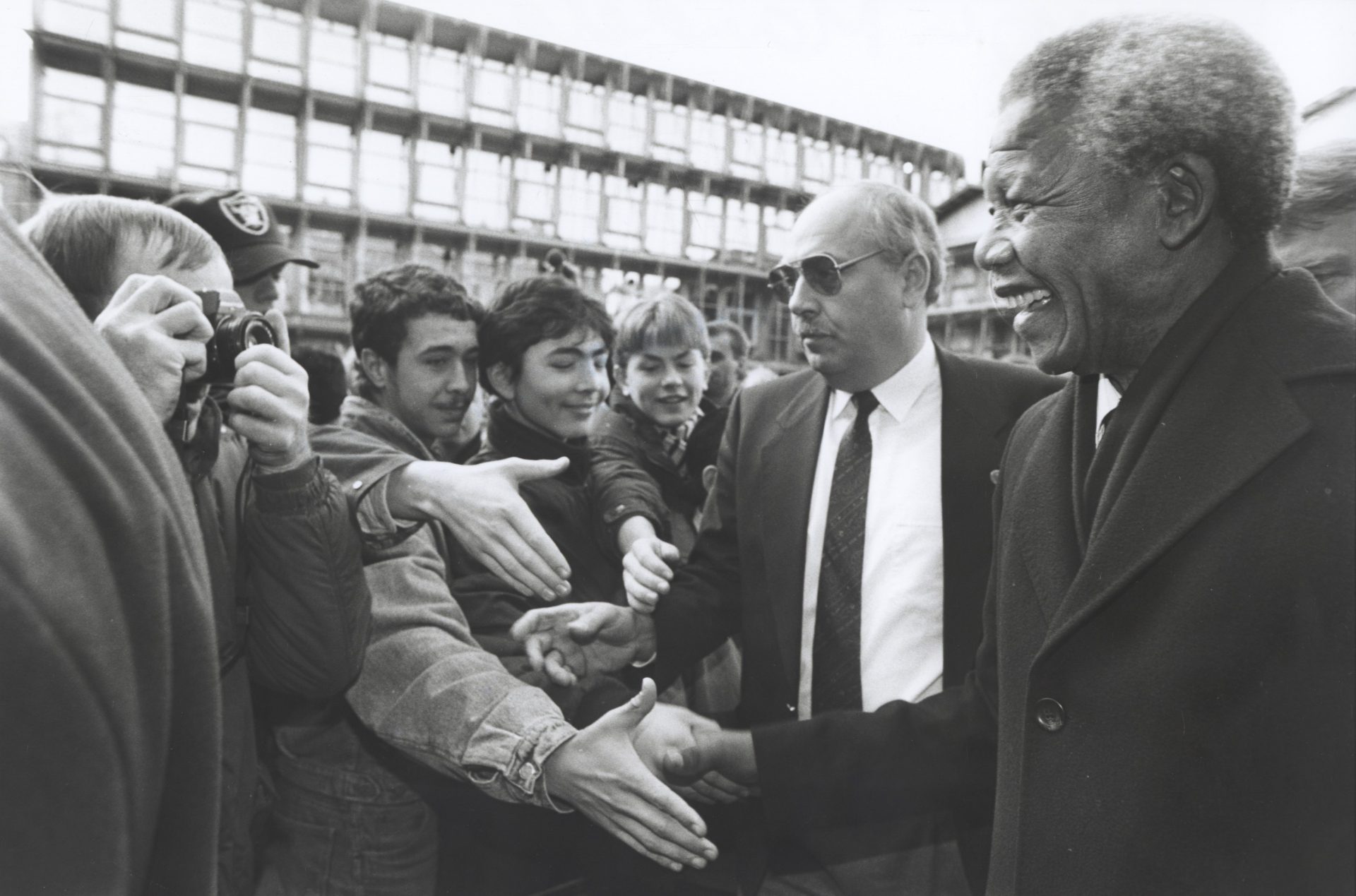
Oliver Tambo in Fælledparken 1960
In 1960, ANC Deputy President Oliver Tambo spoke at the Social Democratic Workers’ May Day rally in Copenhagen. He said it was the first time he had addressed a white audience and he thanked the Danish workers for their support. In particular, he thanked them for the consumer boycott that LO – at the request of the Free Trade Union International – had launched in April/May that year. Tambo’s main message was that the free world had to unite against South African apartheid, which could best be compared to Hitler’s Nazi regime in Germany.
Excerpt from Oliver Tambo’s May Day speech:
“It is a unique experience for me to stand here. It’s the first time in my life that I’m addressing a large white crowd. In South Africa, I would not be allowed to attend, let alone speak […] We are fighting for the same principles that you are united for here. My comrades look to everything you do in the free world. Here in Denmark you have accomplished things that for us are a distant future. In my country, workers fill prisons and jails because they dare to demand equal rights. Think of the wealth that exists in South Africa, and then think of the black people who are kept in a kind of slavery. They are not allowed to organize or otherwise have a say in selling the only thing they have: their labor. I know there are collections going on all over the world to help us. The free trade union movement supports us and I know that Denmark’s LO has started a lottery to help us, among others. Remember that those who have been arrested in the last month are mostly poor people. We need financial support for the struggle we are in the middle of…” (Aktuelt 2.5.1960)
Oliver Tambo’s visit and the boycott campaign, which was supported by a large part of the Danish population (including Irma and Brugsen), was a success in the sense that the racist apartheid system in South Africa was put on the political agenda in Denmark.

The National Committee South Africa-Action – South Africa Committee in Copenhagen 1978-1994
The formation of the National Committee South Africa-Action (LSA) in March 1978 marked the beginning of a more coordinated grassroots resistance to apartheid in Denmark. The background was, among other things, the Soweto Uprising in 1976, where more than 600 mainly young people had been killed by the South African police.
Behind the founding of the country committee were World University Service (today Ibis), Mellemfolkeligt Samvirke, the South Africa Committee in Aarhus and the South Africa Coordination Group (Copenhagen). Several different youth, trade union and church organizations as well as political parties such as the Left Socialists, the Socialist People’s Party, and the Danish Communist Party supported the project and were part of the LSA’s board of representatives.
In the early years, LSA’s activities consisted of fundraising for the freedom movement African National Congress in South Africa (ANC) and the South African Congress of Trade Unions (SACTU), as well as boycott campaigns against South African goods and Danish companies that traded with South Africa.
After a quiet period in the early 1980s, activities picked up again from 1984. With the help of the trade unions in the LSA and the Copenhagen activists (from 1985 the South Africa Committee in Copenhagen (SAKK)), an ANC representation was established in Copenhagen in 1984. In 1985, the first joint Nordic Operation Day’s Work was initiated, raising funds to build refugee and education centers for South Africans in Tanzania. In 1986, campaigns such as “Run against Apartheid” and “Rock against Apartheid” were launched
South Africa Contact: Minutes
South Africa Contact: Case files 1979-1986
South Africa Contact: Case files 1986-1998
After the sanctions were imposed in 1986, a large part of LSA’s resources were devoted to monitoring compliance with the sanctions. In collaboration with Mellemfolkeligt Samvirke, a monitoring agency was established, which, among other things, reviewed trade statistics and South African advertisements to find possible lawbreakers in the Danish/Nordic business community.
South Africa Contact: Mellemfolkeligt Samvirke
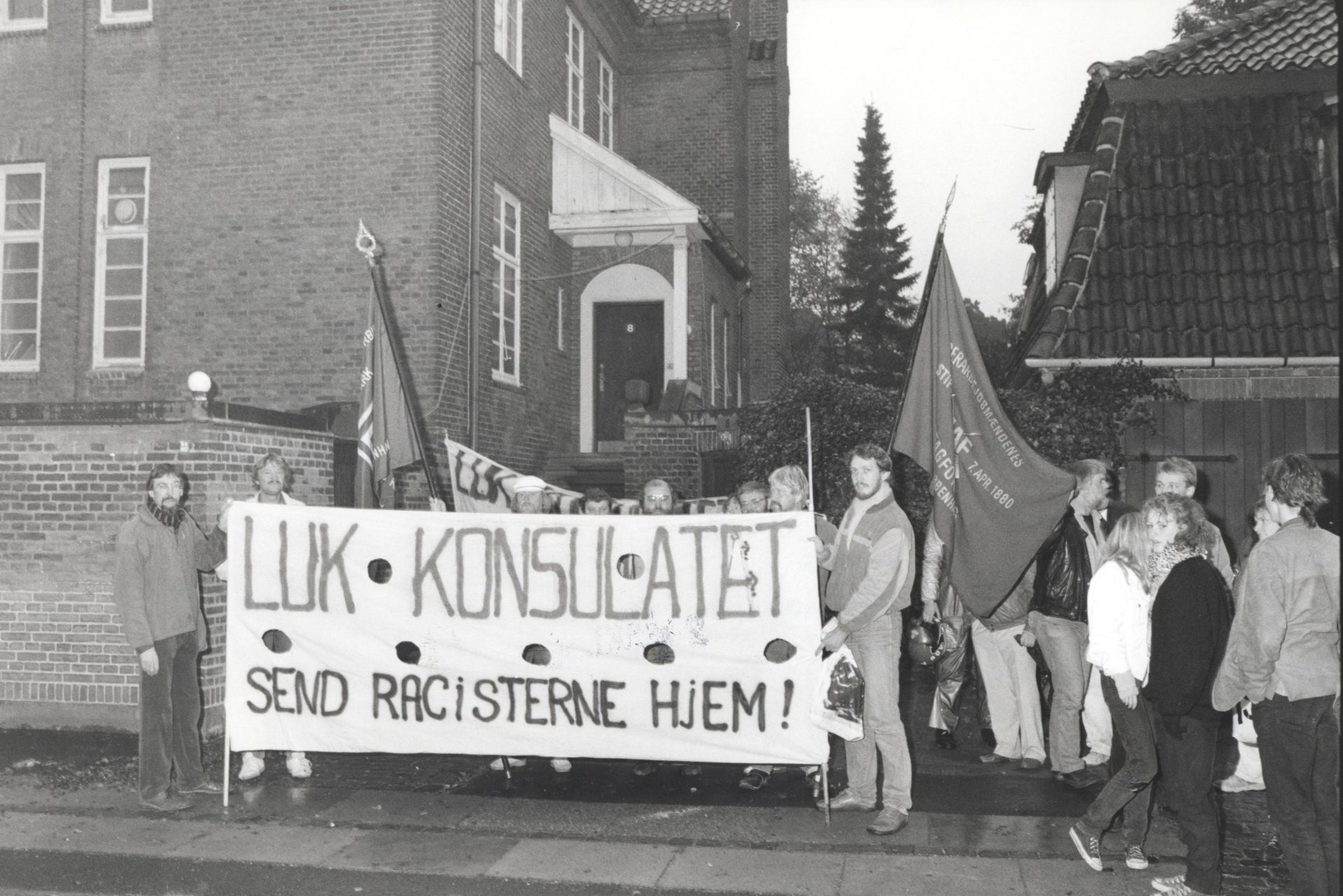
In 1987, the campaigns became more spectacular. For example, in collaboration with Byggefagenes Samvirke, a 500-day blockade of construction work at the South African embassy in Hellerup was set up. The case ended at the Labor Court with fines for several unions.
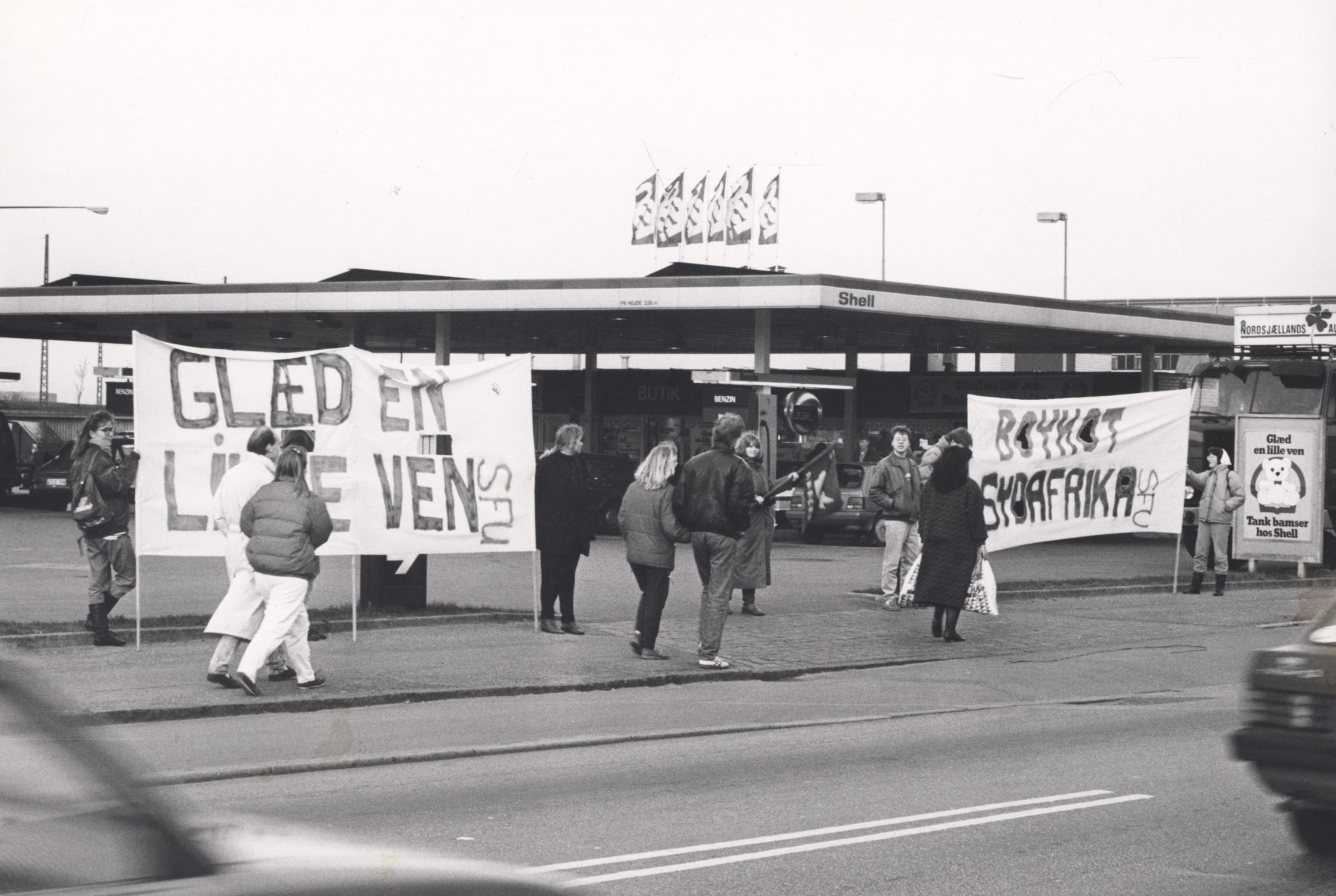
With the Shell campaign the same year, grassroots resistance against South Africa reached its peak. Building on a European campaign and based on the SAKK, the Shell campaign mobilized many new, young activists (e.g. from the squatter community) with its cross-border actions and created a lot of public attention. In the short term, Shell lost market share in Denmark, but as the actions became increasingly violent during 1988-1989 (e.g. arson attacks on gas stations), the campaign lost sympathy among the general public. The process culminated in the Phantom campaign (“Copenhagen apartheid-free city”), which ended with police searching the LSA and SAKK’s joint office and activists from SAKK/Unge mod Apartheid being arrested and later convicted of vandalism.
South Africa Committee in Copenhagen Archive: The Shell campaign
One of the consequences of the events was that both the LSA and SAKK lost the right to support from the tip funds. Another was that LSA/SAKK took a self-reckoning. The concept of ‘direct action’ was distanced, which meant that some activists left LSA/SAKK in favor of Youth Against Apartheid.
The South Africa Committee in Copenhagen Archive: Subject-related cases
On April 27, 1994, South Africa transitioned from apartheid to democracy. South Africans were given the opportunity to vote in the country’s first free elections. The ANC and Nelson Mandela won the election and a new era began for the country.
South Africa in the ABA archives
The material relating to South Africa and the anti-apartheid struggle in the ABA’s archive collection falls into four main groups.
Firstly, there is material relating to the inter-political solidarity organizations that were formed as part of the grassroots organization of the Danish struggle against apartheid. In October 2003, ABA received the archives of the National Committee South Africa Action/Sydafrika Kontakt and the South Africa Committee in Copenhagen from South Africa Contact. The archive material primarily covers the period 1977-1993.
The archives document the organizations’ work and policies. They include minutes from the initial meetings in 1977, where the formation of the National Committee South Africa-Action was planned, from committee meetings/general assemblies, from executive committee meetings, from activist meetings and from working group meetings, etc. In addition, there is the organizations’ correspondence and material from the many campaigns that were launched to raise awareness of the situation in South Africa.
South Africa Contact Archive
South Africa Committee in Copenhagen Archive
Anti-Apartheid Denmark Archives
The Social Democratic Party did not participate in the National Committee South Africa Contact. The party generally distanced itself from collaborating with communists (both domestic and foreign) and until the mid-1980s opposed a unilateral Danish trade boycott of South Africa. Material regarding the Social Democratic Party’s South Africa policy:
Jens Otto Krag Archive
Kjeld Åkjær Archive

LO’s archive, which contains many cases relating to the apartheid regime in South Africa, is part of the group for the trade union movement and other trade union organizations’ work against apartheid:
LO’s archive
National Organization of Apprentices and Young Workers Archive
National Organization of Students (LOE) Archive
Danish Metalworkers’ Union Archive
Central Organization of Industrial Employees in Denmark Archive
Finally, there are the left-wing parties that were involved in both trade unions and solidarity organizations, but there is also material on South Africa in the parties’ own archives:
Communist Labor Party Archive
Danish Communist Youth Archives
Socialist Workers Party Archive
Danish Communist Party Archive
Ole Sohn Archive
The list is not exhaustive, but it provides references to the important files and archives that can document the Danes’ energetic work in the fight against apartheid. Other organizational and personal archives also contain relevant material, but here we only refer to the existing registrant records.