 Search
In the banquet hall you can listen to the sound and light installation Voices of the Banquet Hall, which consists of four sound collages and 20 working songs. The work was created in 2021 by director Astrid Hansen Holm and composer Sandra Boss from Kunstnerkolletivet Von Trapp.
The Voice of the People was added in 2024 and is made by Astrid Hansen Holm and composer Kristian Hverring. Technical design by Tue Selmer. Lighting by For the Love of Light.
Here you can read more about the content of the audio stories and the events they are based on:
1. the International Voice
The secret congress of the German Social Democratic Party in April 1883
The Social Democratic newspapers in several countries had spread the word that the congress was taking place in Austria, while 60 German Social Democrats were staying in Copenhagen. They managed to hold the congress before they were discovered.
The Great Lockout of 1899 and the many letters from abroad
The September Agreement was signed on September 5, 1899 after the largest lockout in Danish history; the lockout was called a hunger war that tested workers’ endurance. Letters arrived from all over the world with monetary contributions.
The Eighth International Socialist Congress
In 1910, 900 social democrats from 23 countries attended the Eighth International Socialist Congress. On September 1, a number of local electoral associations announced that Rosa Luxemburg would speak in the ballroom.
Mandela’s visit to the Ceremonial Hall on February 4, 1992
Nelson Mandela spoke at the Ceremonial Hall on February 4, 1992. After 28 years in prison, he visited Denmark. Now he had the opportunity to thank the Danish people for their support for his ANC party.
The workers’ choir sings the American civil rights song We Shall Overcome.

2. THE VOICE OF WOMEN
List of organized women in different professions
The figures are taken from Nelly Hansen’s speech from the Women’s Congress in London in 1899 and Elisabeth Mac’s speech at the Women’s Congress in Copenhagen in 1910.
May speeches
In 1899, female speakers appeared for the first time on May Day at Fælleden. The politician Nina Bang believed that the eight-hour day would give freedom to both women and men. Olivia Nielsen, chairwoman of the Women’s Workers’ Union, called for equal pay for equal work.
Audio clip from the Nurses’ strike for higher pay in 2021
100th anniversary of women’s municipal suffrage in 2008
Former President of the Swedish Trade Union Confederation Lizette Risgaard’s speech gives a perspective on how little women’s struggle for equality has progressed in 100 years.
3. the voice of the building
In flight, time passes over the wave of life
The workers’ choir sings U.P. Overby’s song, which was sung at the inauguration of the hall.
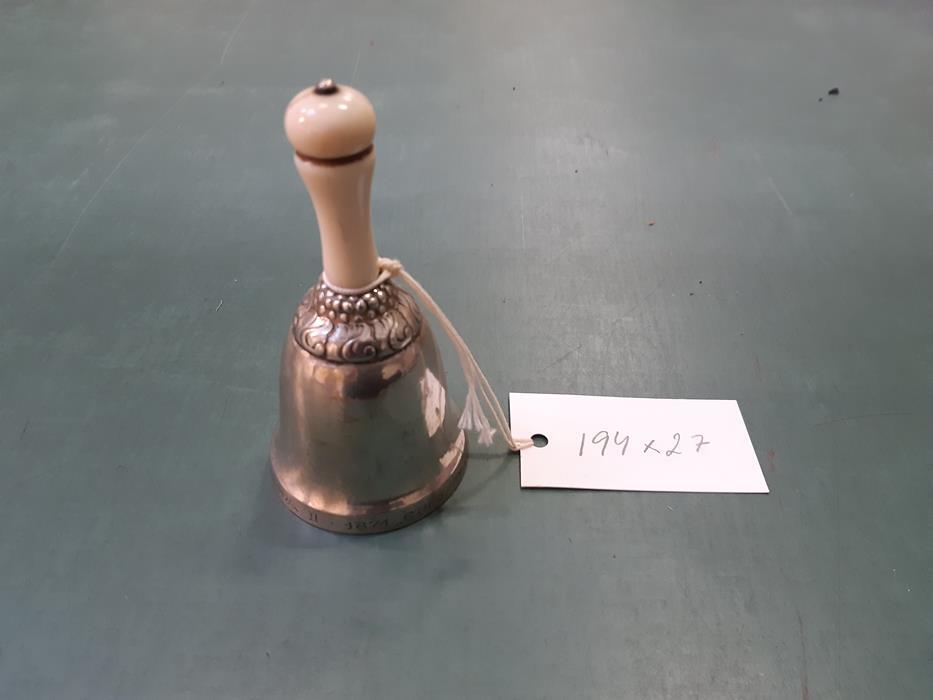
Conductor bells from the Labor Museum’s collection. The role of the bell is to structure and bring order to a meeting.
Archive recording from various associations’ general assemblies and meetings.
Archive recording from the cultural magazine Hvad som helsts Christmas party in 1979.
Archive recordings of various politicians’ speeches and readings, including Stauning, Aksel Larsen, Anker Jørgensen, Hans Hedtoft.

4. the voice of the people
Stauning’s speech at the opening of Roskilde Workers’ Folk High School 1930
In 1929, Arbejdernes Oplysningsforbund bought and took over the management of Roskilde Folk High School, which had been a general Grundtvigian folk high school since its foundation in 1907. The folk high school became the country’s second working-class folk high school. At the opening of Roskilde Folk High School on June 9, 1930, then Prime Minister Thorvald Stauning gave the opening speech.
Selma, student at Esbjerg Folk High School in the 1920s
Esbjerg Folk High School was the country’s first working-class college founded in 1910. A student named Selma Kristensen talks about the importance of both men and women jointly engaging in educational work.
Grethe Bruun, crafts consultant, AOF Copenhagen branch 1967
AOF’s wide range of courses also offered a large number of sewing and needlework courses. Here, women in particular could find meaningful communities outside the home. It also gave women the confidence to sew and create something themselves.
Carina Helligsø Allentoft, dyslexia student 2021
In recent years, AOF has worked actively with dyslexia education (OBU), to the great benefit of people with dyslexia.
Nathalia Zak, language student 2017
AOF offers a wide range of language courses, including Danish courses for foreigners like Nathalia. In addition to learning the Danish language, the students enjoy a rewarding community of like-minded people.
John Meinert Jakobsen, CEO of AOF 2024
John Meinert Jakobsen’s speech at AOF’s 100th anniversary celebration on January 9, 2024.
Workers’ songs
All over the world, wherever there are movements, there is song. In the labor movement, song has helped express the very idea of solidarity. There are hundreds of workers’ songs for different purposes: marching songs, spring songs, peace songs, women’s songs, fight songs and protest songs. 20 songs were sung by the Workers’ Choir, which was founded on this occasion. Some of the singers came from the existing October Choir.
Soon it will be time, brothers (March of the Socialists) – Text: U.P. Overby, Composer: C.J. Rasmussen, 1871
In flight, time passes over the waves of life (Workers’ song) – Text: U.P. Overby, Melody: German folk melody, 1875
Fallen are now the last barriers of winter / The 8-hour song – Text: A.C. Meyer, Melody: O. Linblad, 1890
Even though we are women, Text and melody: Unknown, 1900
Hello, what a glorious wind, now summer is blowing in – Text: Jeppe Aakjær, 1904
Jens Vejmand, Text: Jeppe Aakjær, Melody: Carl Nielsen, 1905
Tyende-Sang / Her kommer fra dybet den mørke arme, Text: Jeppe Aakjær, Melody: Niels Clemmensen, Johannes Torrild, 1907
Arise you damned here on earth / International. Text: Hans Laursen. Melody: Pierre de Degeyter, 1911.
Brothers, let arms be raised. Text: Oskar Hansen, 1919, Melody: Russian Student Song.
When I see a red flag fly / Young flag song. Text: Oskar Hansen, Melody: Johannes Madsen, 1923
Denmark for the people – Text: Oskar Hansen. Melody: Oskar Gyldmark, 1934.
Kringsatt av Fiender / Til ungdommen – Text: Nordahl Grieg. Melody: Otto Mogensen, 1936.
Sangen om Larsen – Text: Svenn Møller Kristensen, Melody: Koppel and Christensen, 1936.
We Shall Overcome, Text and melody: Pete Seeger, 1963.
The Chain – Text: Halfdan Rasmussen. Melody: Benny E. Andersen, 1969.
Fællessang (Er du enlig mor i Esbjerg?) – Text and melody: Women in Denmark, 1973.
Rosa Danser, Text and melody Troels Trier, 1970.
Hope Computer! – Text and melody: Lars Madsen aka Søren Sidewind, 1974.
Do you hear someone calling – Text: Carl Scharnberg. Melody: Peter Abrahamsen, 1976.
To learn is to want to. Text: Halfdan Rasmussen, 1949. Melody: Erling Lindgren, 1985.
colophon
The work is performed by: Astrid Hansen Holm and Sandra Boss from Kunstnerkollektivet Vontrapp in collaboration with Arbejdermuseet in 2021.
Director/dramaturge: Astrid Hansen Holm
Editing and Sound Design: Sandra Boss
Studio technician and mix: Eske Nørholm
Producer: Christian Henckel Lund Nielsen
Coding: Taintec by Tue Selmer Friborg
Lighting: For the love of light
Sound archive: Labor Movement Library and Archive
Choir conductor: Susanna Wium Hallstrøm
Actors/Voices:
Nina Bang: Ina Miriam Rosenbaum
Olivia Nielsen: Marina Bouras
Vilhelm Liebknecht: Constantin Gindele
Rosa Luxemburg: Katrin Weisser
Social-Demokraten reporter 1: Lars Knutzon
Social-Demokraten reporter 2: Kristian Bonde Jørgensen
Narrator voices:
Julie Sten-Knudsen, Lizette Risgaard, John Larsen, Josefine Albris, Julie Thalund, Kristina Funkeson, Timo Gerritsjans, Dominique Jal, Jon Skulberg
Music:
Translated Motion by Sandra Boss
Adventure by Sandra Boss & Jonas Olesen
Electric Storm by Dorit Chrysler
Circle, Delicate Memories and Dream Delight by Band Ane
We shall overcome by Pete Seeger
International by Hans Laursen/de Geyter
In flight, time passes over the waves of life by Overby
When I see a red flag fly by Oskar Hansen
The Workers’ Choir
Anne-Marie Nielsen, Dorthe Pedersen, Else Guldager, Eva Reinwald, Svend Nielsen, Inge Kofoed, Inge-Lise Palbo, Jan Lars Nielsen, Jørgen Nyeng, Keld Hedstrøm, Ole Gleerup, Ann Dorthe Engelhardt, Camilla Meyer, Bjarne Ørbekker, Casper Dahl Stenfelt, Else Langballe, Hanne Eriksen, Jane Frimand Pedersen, Jannick Neumann, Jørn Petersen, Kirsten Buch Ohlsen, Michael Neumann, Rasmus Ladegaard Slot, Uffe Jakobsen